


In Their Resilient Era
BOSS picked the brains of ERA-co global director Steven Cornwell and global sustainability lead Russell Fortmeyer for their ideas on resilient city design.
How cities can design themselves into climate-adaptive sustainability
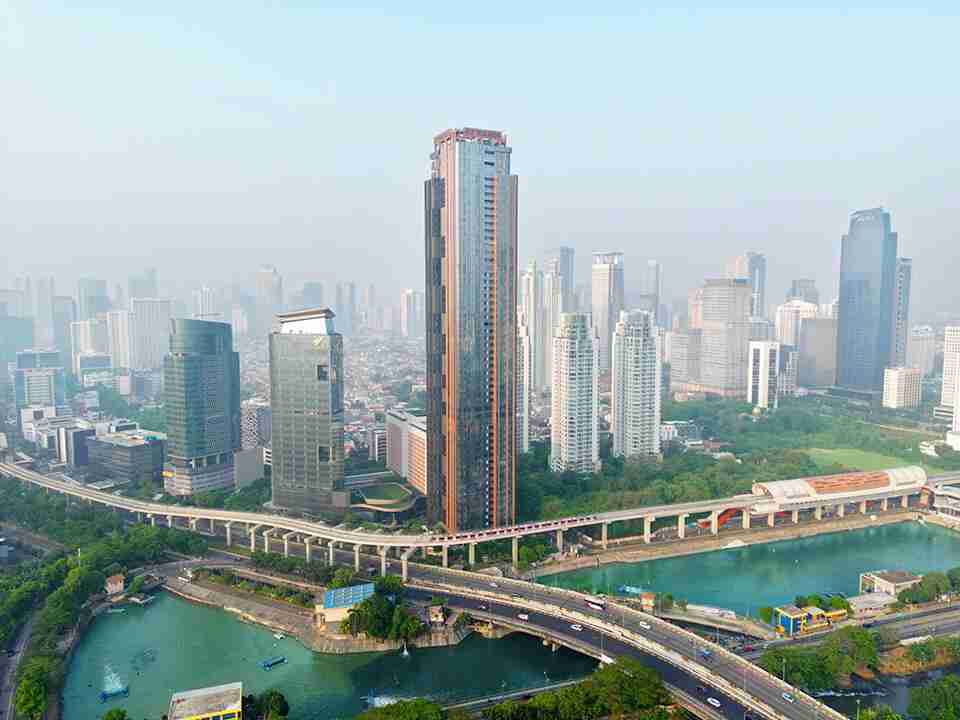
Some cities are more ready to face the future than others. The Indonesian capital of Jakarta, which became a city of more than 10 million people without a real plan for such an occurrence, is sinking. About 40% of Jakarta is below sea level, with that number rising every year as the city sinks by about 2 inches annually. The situation has become so unsustainable that Indonesia is building a new capital city, Nusantara, on Borneo, hundreds of miles away from Jakarta, which is on the island of Java.
“One of the challenges that we face as developers, as makers of cities, is that a lot of city infrastructure is falling under the weight of huge populist demands,” Steven Cornwell, global director of ERA-co, told BOSS.
It can be hard to recover, especially without the right planning, and we’ve seen examples in the past of once-powerful cities brought low by climatic changes.
“We get a bit shortsighted and we think, ‘Well, these big cities are resilient and they’re impervious to potential decay and falling over,’ and they’re not,” Cornwell said. “It’s 500 years in the making to get there, but this is what cities are facing, is that they’re not impervious to decay.”
ERA-co, which styles itself as a global place consultancy, has worked with the likes of Google, Lendlease, and Mirvac. Its portfolio includes regenerative projects like the upper grand canal in Jeddah, Saudi Arabia, net-zero ones like MC2 in Masdar City, UAE, and adaptive reuse ones like the University of Tasmania Forestry building. BOSS picked the brains of Cornwell and ERA-co global sustainability lead Russell Fortmeyer for their ideas on resilient city design.
Placemaking
Talk with them long enough, and you’re sure to hear the term “placemaking.” Cornwell described it as “full ecosystem thinking.” Rather than seeing just buildings, developers need to envision the people who will live there, the neighborhood that will grow up around those buildings, and how they fit in with the surrounding community, and design around that.
“The one person that’s usually not involved in the process of any project is the end user,” Cornwell said, but their needs have to be accounted for.
Placemaking is fundamentally rooted in the natural environment, Fortmeyer said. Humans are part of nature and need to see and feel that daily to establish a connection with a place. Incorporating the built environment into the natural one becomes an ecosystem process of understanding how all things coexist and creating places where people can succeed.
“Everything we do has to be transformative,” Cornwell said. “It can’t be lazy, and we certainly have to think about advancing humanity in every single project. Hopefully, the echo and the reverberation of the work that we do today has a positive impact on the planet and on humans.”
Placemaking connects the hardware of buildings with the human dimensions of a project.
Social Sustainability

That placemaking is not happening in developments like the luxury high rises along Manhattan’s Billionaire’s Row, where buildings sit half-empty and owners use the apartments more for parking money than for living.
“Our cities will fall under the weight of a growing number of those things happening, when we should be thinking about what the city needs,” Cornwell said. “The affordability crisis, for example, is a social sustainability nightmare for everyone. The future of where people live will be determined by whether they can afford to live there. What does that mean for cities?”
If people who work in the city center can’t afford to live there, they’ll move to outer areas, putting strain on existing infrastructure like transportation and requiring more of it. Issues like affordable housing and where people perform work are major issues cities face in their drives for sustainability, along with climate issues. Developers, as placemakers, have a responsibility to make sure they’re utilized and don’t become cultural deserts, Cornwell said.
Cities like London and New York that have adopted comprehensive building regulations around carbon are making the most progress in making themselves resilient for decades to come, Fortmeyer said. They’re also taking steps to make their cities more livable.
The University of Tasmania Forestry building is not only being designed with a circular materials strategy and low carbon impact, it’s part of an intentional decision on the university’s part to activate the Hobart city center and acknowledge the university’s place as an institution vital to the city’s well-being.
“It’s not just the carbon story for that project, it’s the social sustainability story that it’s really about, ‘This is a meaningful part of everyone’s daily life.’ It’s not a place you go to once and then you leave after four years.”
Programmatic Flexibility
The difference between the rapid post-World War II development of Jakarta or the decline of cities like Cairo today is that we have the data to inform design decisions, Fortmeyer said. It’s standard to do climate risk assessments prior to development, especially in low-lying coastal cities vulnerable to rising sea levels. Those assessments drive decisions about where to place infrastructure within cities and even within individual buildings, for example where to put a pharmacy within a hospital.
“We’ve developed internal tools, including the ability to use future weather data to inform these early planning principles,” he said.
Developers globally are taking note of where trends are headed. Electric grids will be cleaner in the next decade, with some even at zero carbon within 15 years, which changes the kind of investments being made as far as how to build a zero-carbon development.
“There’s a different answer depending on if you’re answering that today or if you’re answering that in 15 years.”
Rigorous digital regression analysis can give a city or a developer a strong idea of where trends might take the future of resilient design.
“From a planning perspective, it’s about, if you’re building or planning new development, how do you think about those assets in the most flexible way?” Fortmeyer said.
A building that starts life as a commercial project might soon be used as a laboratory, or as residential space a few decades down the line.
“As designers and planners, we want to think about that future city in terms of making that flexibility easy because the longevity of our buildings is really what we have to think about.”
If a building is technically net-zero but doesn’t last for more than 25 years, Cornwell said, it can’t rightly be called sustainable.
“It’s not easy to do what we’re asking developers to do,” he said.
But if the end result delivers a good-for-all quality for resilient city design, it’s worth it in the long run.


