Legacy of Innovation
We are in a new era of manufacturing. With pandemic lessons learned, manufacturers are bringing production closer to the end user.
Hexagon’s Mariana Prado Cogan on what the new age of manufacturing needs
We are in a new era of manufacturing. With pandemic lessons learned, manufacturers are bringing production closer to the end user. Investment is booming as reshoring and nearshoring deliver new factories and remodeled supply chains. Labor shortages remain an obstacle, as manufacturers try to leverage new technologies to do more with less. It’s an era suited for creative thinkers and problem-solvers. Mariana Prado Cogan, chief marketing officer for Hexagon Manufacturing Intelligence, is one of those people. She spoke with BOSS about what manufacturing needs to deliver success in this new age.
Cultural Principles
Born in Mexico City, Prado Cogan began attending a Japanese school at age 8 then moved to Japan after high school to study economics. She spent 11 years there and has worked in investment banking, business management, and various marketing roles throughout her career.
That time in the trenches helps her communicate well with sales, finance, and product teams, and she’s drawn many lessons from Latin and Japanese cultures that have served her well.
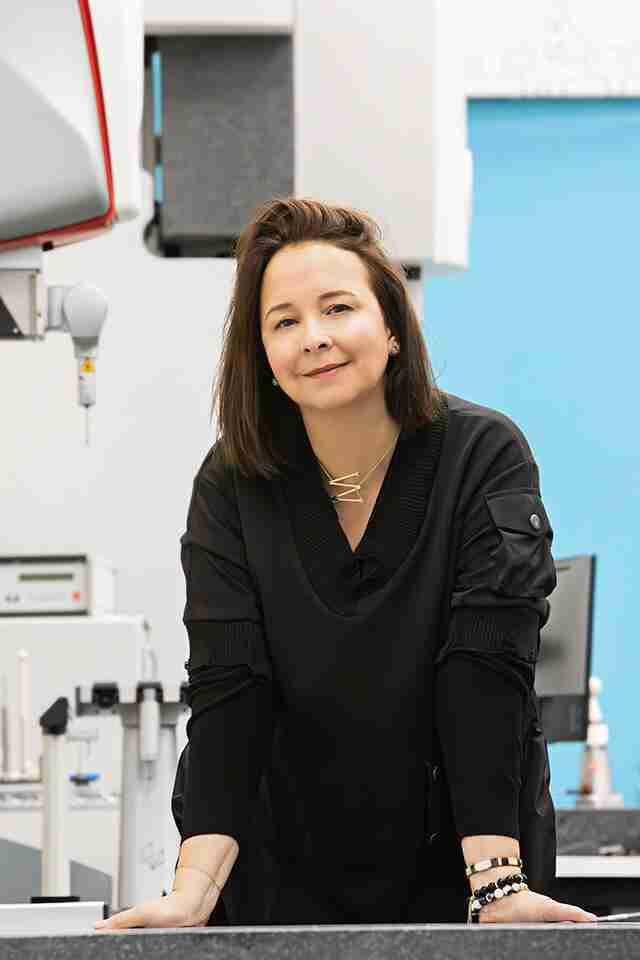
Mariana Prado Cogan
“You think about Mexico and you think about Japan, and they sound like opposite sides of the spectrum,” she said, “but both cultures are really big into building relationships.”
Face-to-face meetings are surefire ways to establish and maintain a relationship with business partners and colleagues. Nemawashi, a Japanese concept of change management that gets all stakeholders on board before formally initiating the change, is a personal favorite. The term comes from the process of transplanting a tree, where one digs around the base of the tree and allows new roots to grow before moving it to its new location.
“You don’t just pull the tree and try to take it with you,” she said. “Make sure everybody’s coming with you first, then it grows healthier. It’s the same when it comes to business.”
In Latin culture, there’s a great emphasis on being creative and finding solutions. Blending the two cultures, Prado Cogan said, has yielded countless leadership lessons.
Leveraging Tech

Hexagon’s digital solutions support the development and production of 95% of cars, 90% of aircraft, and 75% of smartphones produced.
“Helping companies accelerate their innovation while reducing waste is where we’re going to leave our mark on the world,” she said.
As the manufacturing industry navigates a labor shortage and the economic pressure to deliver productivity at a high level, problem-solving is at a premium.
“You have to leverage smart technology so that you can be more innovative, more productive, decrease waste, and be faster to market,” Prado Cogan said.
Manufacturers, from large OEMs to small machine shops, need to invest in new technology to remain competitive. The industry has made huge advancements recently when it comes to smart manufacturing. With the advent of digital twins, AI, automation and robotics, manufacturers can rely more on technology to reduce the labor gap.
With some AI-powered tools, machines can run 90-95% of the process themselves, requiring less labor power and supervision. With CNC machines, AI can now be used within the tool itself to make a lot of decisions. Hexagon’s Esprit Edge, for example, uses information and context input by the manufacturer to predict the best processes to use, reducing programming time by 75%. It does this based on the capability of the machine and past use cases. So, thanks to AI, the person working on the tool will get all the passive knowledge from the people who used the tool previously.
Another way to upskill trainees without putting safety at risk, along with the function of expensive machinery, is running simulations on digital twins like Safran Aircraft Engines does. Trainees can repeatedly practice complex tasks and scenarios, and manufacturers can create flexible, efficient training schedules.
EV battery manufacturers can use digital twins to explore configurations that will weigh less and therefore cost less to produce.
“Smart manufacturing is finally fully here, so first off, manufacturers need to educate themselves and stay up to date about what’s now available out there from a technology perspective,” Prado Cogan said. “It’s changing every day and there are so many more options out there to help you do more with less.”
Woman’s Work
As technology picks up the slack, Prado Cogan sees an untapped resource that could fill the more 600,000 manufacturing job openings in the U.S. It’s the approximately 3 million unemployed women across the country.
“These are jobs that do not require a college degree and do not require the heavy lifting that we used to think in regard to manufacturing,” she said.
In this era of smart manufacturing intellectual prowess outweighs physical strength, but the stereotypes remain.
“This is why it’s so important to have manufacturing equipment and education in high schools, trade schools and universities. We need younger generations to see it for what it is: an exciting, viable career path.”
Women can perform various roles across different sectors, crafting anything from high-tech electronics to consumer goods, she said. The average woman in manufacturing makes between $63,000-83,000 per year, higher than many other fields, yet women make up only a third of the manufacturing labor force.
“At the end of the day, more diverse companies are more innovative, and more innovative companies are more diverse,” she said.