


Why Beauty Brands Lead Experiential Marketing and How Pop Up Mob Fits In
Written By: BOSS Editorial
Reading Time: 7 minutes
Beauty leads experiential marketing not just because its products are sensory, but because the category has evolved into a lifestyle space. Product launches, influencer events, retail takeovers, trade show booths, and guerrilla sampling campaigns all run year-round across beauty brands of every size.
A Gradient Experience study surveying over 750 senior marketers across 12-plus industries found that 84% of beauty and skincare companies increased their experiential budgets over a three-year period. Two-thirds of beauty companies allocate between 10% and 30% of their total marketing budget to experiences and events, and a quarter allocate more than 30%. Those figures place beauty among the top industries for experiential investment.
Cosmetics, skincare, haircare, and fragrance are inherently experiential categories, where trial, storytelling, and environment all influence purchase decisions.
Pop Up Mob is a global experiential agency that has produced over 250 activations for more than 175 brands across 15-plus industries. Beauty has been a major driver of the company’s growth since its founding in 2014 by Ana Corina Pelucarte and Rita Tabet. In beauty, the agency operates as a strategic partner, translating brand positioning, campaign narratives, and product innovation into physical experiences that drive trial, content, and conversion. Pop Up Mob’s beauty clients include Rare Beauty, Benefit Cosmetics, OUAI, Sol de Janeiro, Huda Beauty, Supergoop!, Patrick Ta, Nutrafol, JVN, Goop, Kate Somerville, and Bondi Boost, among others.
Why Beauty Brands Invest More in Physical Experiences
74% of consumers say that engaging with a branded event makes them more likely to buy the promoted products, according to EventTrack research. For beauty, that number carries even more weight because the purchase decision often depends on texture, scent, shade, and application feel. No amount of video content or influencer endorsement fully substitutes for trying a blush on your own skin or smelling a fragrance in person.
Physical experiences also function as content engines. 98% of event attendees create digital or social content during brand experiences. Beauty pop-up events are designed with this in mind, featuring photo-ready installations, branded backdrops, and interactive product moments that attendees photograph and post organically.
ClickZ’s 2026 beauty marketing analysis noted that pop-ups and flagships have become full experiences with themed spaces, gamified installations, and social-friendly design. Sephora, Ulta, and specialty chains now treat stores as content engines as much as sales channels. Beauty retail, in that sense, has turned into a theater.
Beyond trial, these experiences also function as community-building moments, where brands move from products to platforms and from audiences to active participants.
How Beauty Activations Differ From Other Categories
Beauty pop-up events carry production requirements that other consumer categories do not. Shade-matching stations, product testers with sanitation protocols, on-site aestheticians or makeup artists, skincare consultations, and fragrance sampling bars all require specialized staffing and setup.
A pop-up for a fashion brand can display garments on racks. A pop-up for a beauty brand needs trained educators who can walk a consumer through application, ingredients, and product pairing.
Pop Up Mob handles this through its full-service model, managing everything from concept development and creative direction through staffing, training, POS integration, and on-site operations. The agency’s approach builds the physical environment around a narrative tied to the brand’s message, which, in beauty, means connecting design choices to the sensory experience of using the product.
Pop Up Mob uses a process it calls render to reality, where high-fidelity 3D renderings of the finished space are produced before fabrication begins. For beauty clients, this means every product display, mirror placement, lighting choice, and consumer journey touchpoint is visualized and approved before construction starts.
This added complexity reflects a broader role: beauty activations are not just about showcasing products, but about proving performance, building trust, and creating a branded environment consumers want to return to.
Sol de Janeiro Influencer Event in Scottsdale
Pop Up Mob partnered with Sol de Janeiro to design and bring to life an immersive influencer experience in Scottsdale, celebrating the launch of the brand’s Delícia Drench body care line. The concept translated the product’s sensorial identity into a physical environment, where every touchpoint, from customization moments to spatial design, invited guests to engage, create, and share.
A product-focused photo moment anchored the event, providing creators with content-ready backdrops to extend the brand’s reach beyond the room. Pop Up Mob led the experience from concept through execution, ensuring every element aligned with the brand’s narrative and content strategy.
Influencer events serve a specific function in a beauty brand’s marketing calendar. They generate earned media, seed product awareness with high-reach creators, and produce visual content that supports paid and organic campaigns for weeks after the event ends.
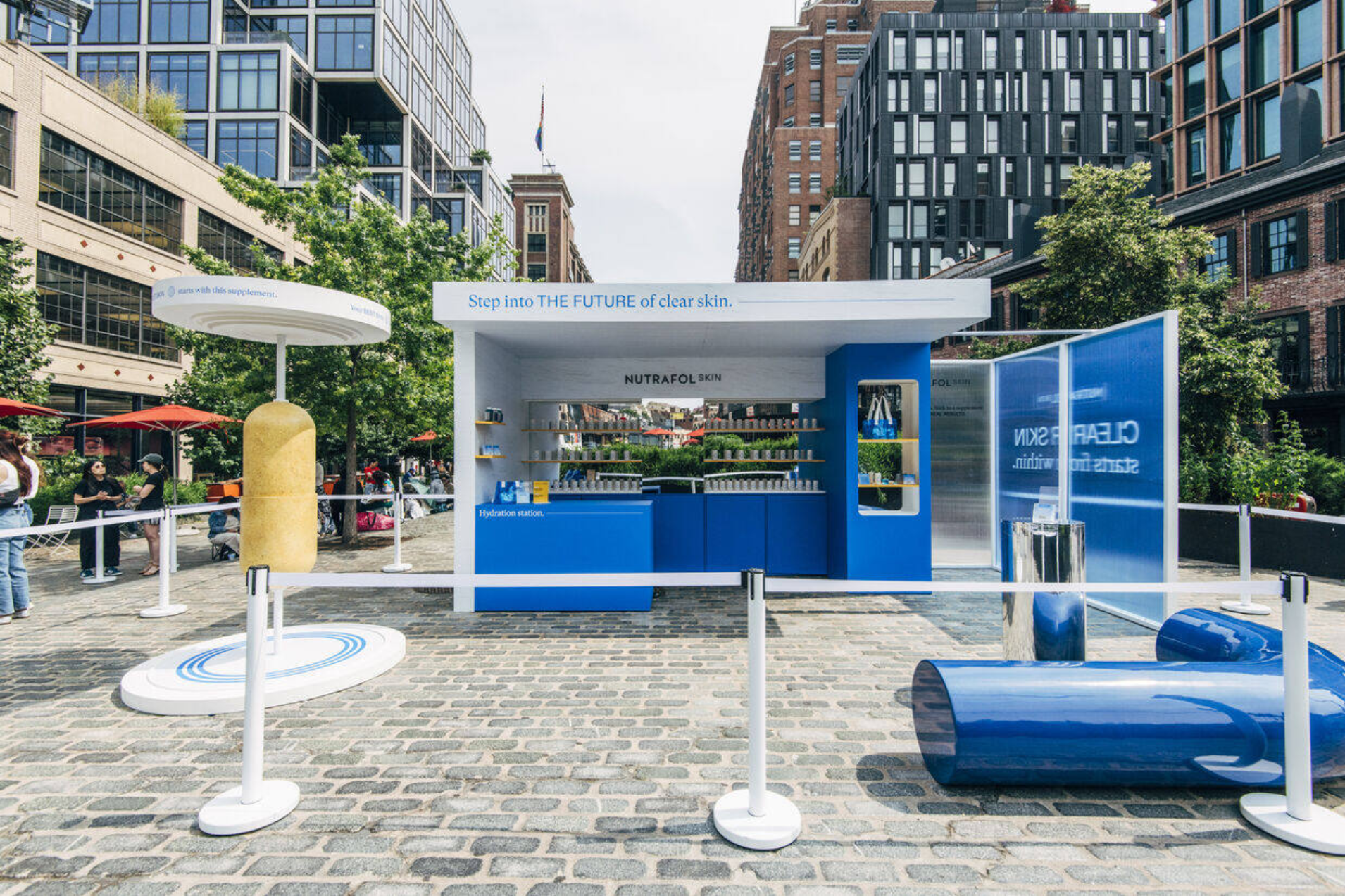
Nutrafol SKIN NYC Pop-Up in 2025
Pop Up Mob partnered with Nutrafol to conceptualize and deliver a New York City pop-up in 2025, supporting the launch of its SKIN line and the brand’s expansion beyond hair wellness into skincare. The experience was designed to translate a new category into something consumers could explore, understand, and trust in a physical environment.
For a brand entering a new category, the challenge is not just visibility, but belief. Unlike topical products, supplements cannot be experienced instantly, making education and credibility critical to adoption. The pop-up addressed this by turning complex science into accessible, engaging moments, allowing visitors to understand how the product works and how it fits into their routines.
Pop Up Mob led the activation from concept through execution, designing a space where environment, storytelling, and guided interactions worked together to build confidence in the product. Pop Up Mob’s operational model includes staff training on brand messaging and product knowledge, which ensures that on-site educators deliver accurate and consistent information throughout the run.
What Format Works for Which Beauty Objective
In beauty, format is not just a creative decision; it is a strategic one. Each type of activation is designed to deliver a specific business outcome, whether that is awareness, education, conversion, or cultural relevance. Pop Up Mob’s beauty portfolio spans nearly every format in the category:
- Influencer and VIP events for earned media and creator content (Sol de Janeiro, JVN)
- Standalone pop-ups for product launches and consumer education (Nutrafol, Kate Somerville)
- Retail takeovers and in-store activations for conversion in existing retail environments (Rare Beauty at Sephora)
- Guerrilla sampling for high-volume product trial in public spaces (Goop, Sweet Tooth)
- Trade show booths for industry-facing visibility at events like Ulta FLC and SEPHORiA (Cecred, Supergoop!, Bondi Boost, Patrick Ta)
- Mobile tours for multi-city reach tied to product launches or cultural moments (r.e.m. Beauty, Monday)
Each format carries different production requirements, timelines, and measurement frameworks. Pop Up Mob operates as a one-stop shop across all of them, allowing beauty brands to run multiple activation types with a single agency partner rather than managing separate vendors for each format.
Why Beauty Will Continue to Lead Experiential Spending
U.S. beauty and personal care spending reached $104.74 billion in 2025, with the market forecast to hit $114.8 billion in 2026, according to eMarketer. Beauty is also one of the most resilient consumer categories during economic uncertainty, falling behind only food and general merchandise in terms of sustained spending, according to NielsenIQ.
That market size, combined with the data from Gradient’s cross-industry study, explains the gap between beauty and other categories in experiential investment. Beauty products require a sensory trial before purchase. Beauty consumers generate social content at high rates when given a physical environment worth photographing.
Beauty brands also run activations across more formats (influencer events, guerrilla sampling, trade show booths, retail takeovers, mobile tours, standalone pop-ups) than most other consumer categories.
For brands in the category, the implication is that experiential marketing is not an occasional campaign tactic. It is a recurring line item that spans multiple formats, markets, and objectives throughout the year.
Pop Up Mob’s work across brands like Sol de Janeiro, Nutrafol, Rare Beauty, and others reflects that pattern. As experiential becomes a continuous, multi-format strategy rather than a one-off activation, brands require partners who can connect creative, strategy, and execution into a cohesive system that drives both cultural relevance and measurable growth.


