

How to select sensors for adaptive street lighting
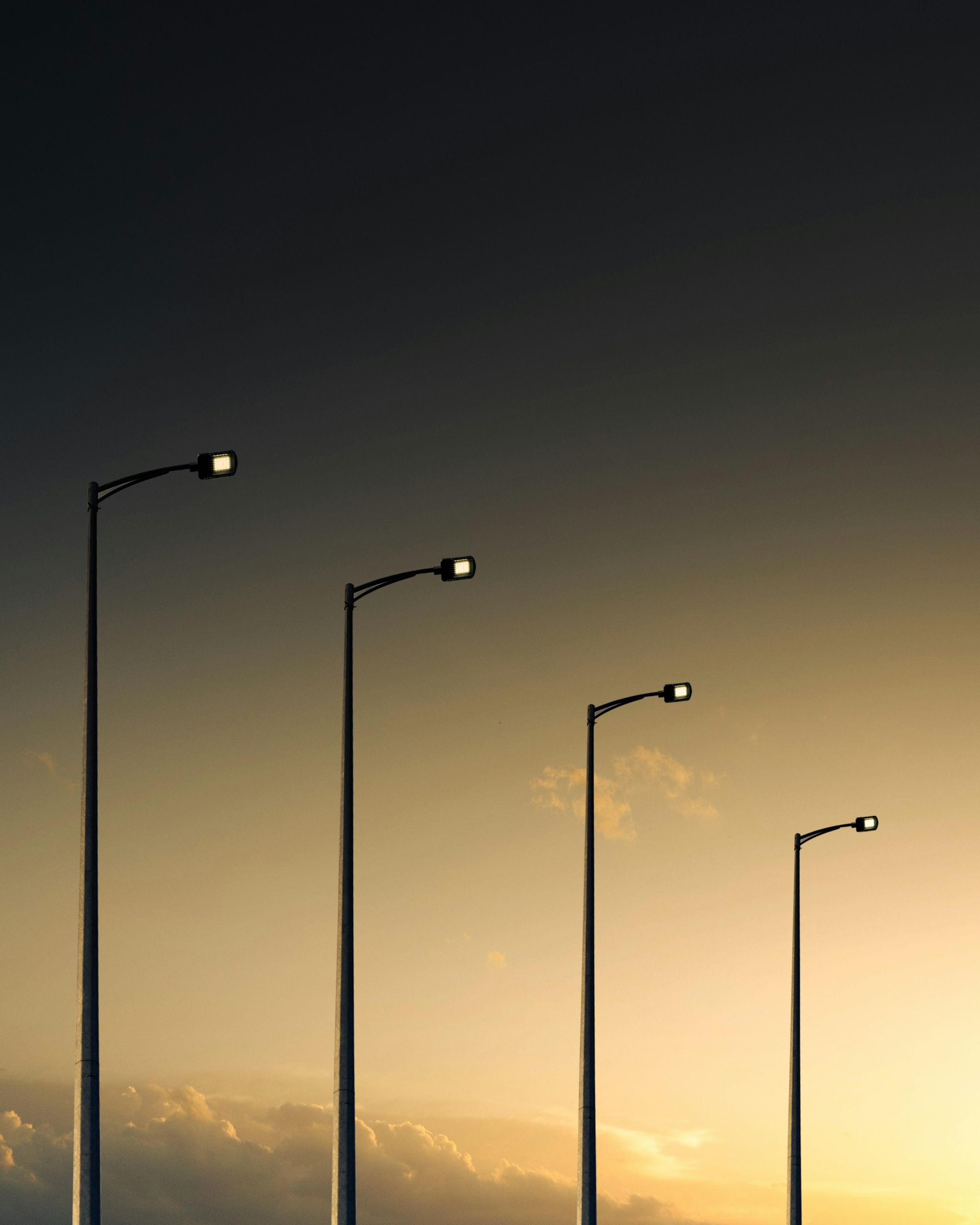
Written By: BOSS Editorial
Reading Time: 5 minutes
Modern street lighting systems increasingly operate based not only on fixed schedules, but also on real-time environmental conditions. Lighting levels can be adjusted according to motion, ambient light levels, and weather conditions.
Different sensors, however, are designed for different tasks. For this reason, system design should start by defining exactly what the lighting system needs to detect: pedestrian movement, vehicle movement, changes in ambient light, or changes in local weather conditions.
Based on the practical experience of DITRA Solutions, a manufacturer of street lighting control and Smart City solutions, four sensor types are commonly used in adaptive lighting systems: PIR, microwave, daylight, and meteo sensors.
PIR motion sensors: For pedestrian areas
A PIR motion sensor detects changes in infrared radiation caused by the movement of a person, animal, or other object whose temperature differs from the surrounding environment.
This type of sensor is well suited for:
- pedestrian paths;
- parks;
- residential areas;
- courtyards;
- cycle routes;
- streets with low nighttime traffic.
For example, lighting along a pedestrian path can operate at a base level of 20 to 30% during low-activity periods. When motion is detected, the luminaires can increase to a predefined output level. After movement is no longer detected, the lighting can gradually return to the base level.
This approach reduces the amount of time luminaires operate at full output while maintaining sufficient visibility and comfort for pedestrians.
However, PIR sensing also has limitations. In very hot climates, the temperature of road surfaces, walls, or other surrounding objects may approach human body temperature. As the thermal contrast decreases, motion detection can become less reliable.
Microwave motion sensors: For vehicles and longer detection range
Microwave motion sensors operate on a different principle. They emit an electromagnetic signal and analyse the reflected signal. Movement within the detection area changes the characteristics of the reflected signal.
These sensors typically provide higher sensitivity and a longer detection range.
They are particularly suitable for:
- parking areas;
- access roads;
- vehicle routes;
- site entrances;
- industrial facilities;
- areas containing glass or plastic structures.
For example, in a parking area it may be necessary to detect an approaching vehicle before it reaches the illuminated zone. A microwave sensor can detect movement at a greater distance and send a signal to the control system so that lighting levels are increased in advance.
High sensitivity can also create limitations. If the detection area is not configured correctly, the sensor may respond to movement outside the intended zone, such as vehicles on an adjacent road.
Daylight sensors: When fixed schedules are not enough
Many outdoor lighting systems are controlled using fixed schedules or astronomical calendars. However, actual ambient light levels are affected by more than the time of day.
They can vary due to:
- cloud cover;
- rain;
- fog;
- shading from buildings;
- local site conditions.
A daylight sensor measures the actual ambient light level and sends this information to the lighting control system.
For example, the DITRA Wire Daylight Sensor measures natural light and transmits the readings to the controller via RS-485 using Modbus RTU. The controller can use these values to switch lighting on or off, adjust dimming levels, or select an appropriate lighting profile.
Daylight sensing is particularly important in tunnel applications.
On a bright day, the difference between external daylight and the lighting level inside a tunnel can be significant. A sudden change in luminance can make visual adaptation more difficult for drivers.
Daylight sensors installed near tunnel portals allow the control system to adjust lighting in entrance and threshold zones according to actual external conditions.
Sensor placement is therefore critical. If the sensor is permanently shaded or exposed to strong reflections, the measured value may not accurately represent the overall ambient light conditions.
Meteo sensors: When weather conditions affect lighting requirements
Another use case applies to roads, bridges, and other infrastructure where visibility can be affected by local weather conditions.
Meteo sensors can be used to provide additional environmental data for these applications.
For example, the DITRA Meteo Sensor measures:
- air temperature;
- relative humidity;
- atmospheric pressure.
These values are transmitted to the control system and can be used as additional inputs when selecting a lighting operating mode.
This is particularly relevant for coastal roads, bridges, and other locations exposed to frequently changing weather conditions.
It is important to note that such a sensor is not a direct visibility measurement instrument. Instead, it provides local meteorological parameters that the control system can use together with other available data.
In addition to lighting control, meteorological data can be stored in a central management platform and used for operational analysis of urban infrastructure.
How to select the appropriate sensor
Sensor selection should begin with the control requirement rather than with a specific device.
If the objective is to detect pedestrians in parks, residential areas, or pedestrian zones, PIR sensing should be considered.
If vehicles need to be detected in advance or over a longer distance, a microwave sensor may be more suitable.
If the lighting system needs to respond to actual ambient light rather than only to a schedule, a daylight sensor is required.
If local weather conditions have a significant impact on lighting operation, meteo sensors can provide an additional environmental data layer.
Sensors as part of Smart City infrastructure
A sensor alone does not make a lighting system intelligent. It only provides data.
The controller and central software must determine what action should follow: increase the lighting level, reduce it, activate a group of luminaires, or switch to another operating profile.
For this reason, sensors should be considered as part of the overall Smart City control architecture.
Lighting poles are already distributed throughout urban areas and have access to electrical power. This makes them practical mounting points for sensors, controllers, and communication equipment, allowing the lighting network to function as a distributed data collection infrastructure.
In DITRA Solutions systems, sensors can transmit data to lighting controllers via RS-485 and Modbus RTU. From there, the information can be forwarded to a central management system.
The main principle of sensor selection is straightforward: first define what information the control system needs from the surrounding environment, then choose the technology that can provide this information reliably.
This allows adaptive lighting to function not only as an energy-saving measure, but also as part of a wider urban infrastructure that responds to actual operating conditions.
Photo by Mukesh Naik on Unsplash
More Articles Like This


From fake to favorite: food’s big flex
Consumer demand for plant-based foods is intensifying, fed by an emerging class of enthusiasts – the flexitarians

Build Without the Bottlenecks: 4 Tools Helping Software Teams Move Faster
Explore four tools helping software teams move faster by improving testing, browser automation, app generation, and AI-ready data infrastructure.

How Steve Rozenberg Went From Airline Pilot to Business Solutions Expert for Contractors
Learn how Steve Rozenberg transitioned from airline pilot to business solutions expert, using systems and structure to help contractors build scalable...

