


Moving Beyond Rule-Based Insurance Software: Is Agentic Automation the Leap Forward?
Insurance software with embedded agentic AI empowers carriers, agents, and brokers to go beyond rigid rules.

Written By: BOSS Editorial
Reading Time: 9 minutes

Straight-through processing and static automation have been a trusted ally of insurers for years. These were meant for simple tasks, wherein data was structured, and scenarios showed minimum variations. But today, these systems falter when handling unstructured data or discerning new risk patterns. Even worse, static automation struggles to deliver digital-native experiences, which are now mere baseline expectations for customers.
Consider a motor claim with blurred images, conflicting witness reports, or out-of-date policy endorsements. Or think of ambiguous medical histories or rapidly changing catastrophe exposures. Legacy systems can’t handle complex portfolios and demanding regulations, resulting in delays, erratic decisions, and higher costs. Thus comes in agentic automation, where autonomous AI agents understand context, reason across data, and own outcomes across end-to-end insurance journeys.
These agents orchestrate end-to-end underwriting, policy servicing, and claims handling, optimizing the processes for business goals rather than executing isolated tasks. Insurance software with embedded agentic AI empowers carriers, agents, and brokers to go beyond rigid rules. This implies that insurers can instantly respond to risks, regulatory updates, and customer interactions.
What Is the Difference Between Agentic Automation and Traditional Automation in Insurance?
If agentic automation is still being viewed as comparable to traditional automation approaches, such as RPA, which primarily replicate predefined human actions, it may be necessary to reassess that perspective. We say so because agentic automation doesn’t simply follow rigid rules but uses NLP, AI, and ML to understand, reason, and act. Take a look at the table to better understand the difference between the two.
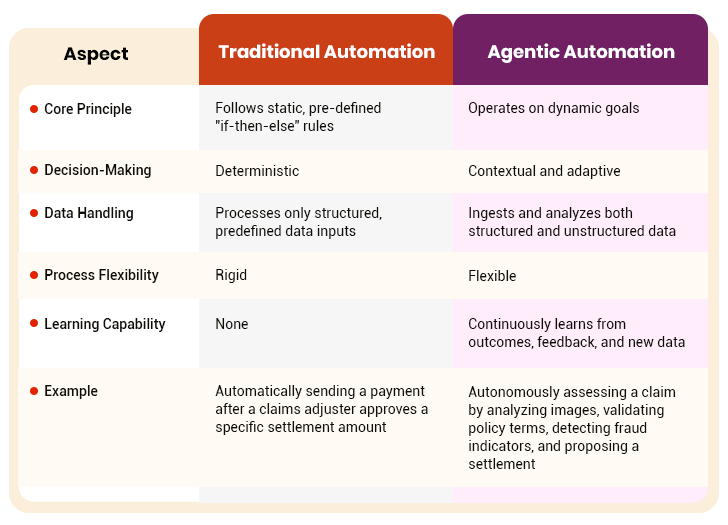
In short, agentic capabilities turn automation from “doing faster” to “deciding better.” An insurance software system with agentic automation capabilities can handle exceptions very well. This ability is particularly important as insurers face new risk classes, such as sophisticated cyber threats and climate-driven events.
Wondering what outcomes can be expected from the adoption of such advanced insurance software? Efficiency and personalization at scale. Not only this, there’s way more that these advanced insurance systems can offer. Let’s explore them one by one in the next section.
What Are the Benefits of Agentic Automation in Insurance?
Agentic automation makes decision-heavy, cross-functional workflows intelligent and adaptive. Rather than optimizing individual steps of the insurance processes, agents can orchestrate end-to-end journeys, from quote-to-bind and FNOL to settlement. The most notable element? This insurance value chain optimization is done without affecting cost, risk, or customer outcomes. Let’s explore the benefits in detail:
1. Accurate Risk Assessment
Agentic automation-based insurance software system can analyze large volumes of submissions, inspection reports, loss histories, and more. What’s more, these solutions can also assess external datasets, such as geospatial or credit information. By continuously learning from outcomes, such as loss emergence and claim behavior, they refine risk segmentation and pricing. The result? Reduced mispriced risks over time.
In commercial property analysis, AI agents combine satellite imagery, local hazard scores, and historical losses to provide a granular view of accumulations and secondary risks. Consider another case of cyber insurance. Here, these AI agents use security assessments reports, breach reports, and industry benchmarks to flag high-risk profiles that appear at low risk under existing scoring methods. This level of precision supports more sustainable combined ratios. What’s more is that underwriters can focus on accounts rather than re-evaluating standard risks.
2. Faster Claims Processing Cycle
Insurance claims are document-heavy, variable, and time-sensitive. There’s no doubt that simple claims, like low-severity motor damage or simple health reimbursements, can be processed in minutes via straight-through automation. But when it comes to complex cases, an insurance software system with agentic automation capabilities is the best. That’s because these solutions pre-assemble evidence, highlight inconsistencies, and propose a detailed course of action so that adjusters can better focus on negotiations.
Intelligent insurance company software can not only capture FNOL across voice, chat, and web channels, but also classify claim types, validate coverage, and initiate appropriate workflows. The best part? All this is done without manual triage. Furthermore, insurers can analyze damage through images and videos and cross-check the results against policy details to recommend reserves or settlement paths. With such intelligent automation, insurers have increased claims processing speed as much as 50%.
3. Higher Operational Efficiency
By design, agentic automation removes the need for constant human supervision of automated tasks. Agents monitor process health, handle exceptions within defined risk bounds, and escalate only where human judgment truly adds value. This reduces manual handoffs, rework, and dependence on email or spreadsheets to bridge system gaps.
Think of an insurance agent managing mid-term policy adjustments. Using the intelligent insurance industry software, they can update data across policy, billing, and CRM platforms while reconciling differences and tracking SLA adherence. Moreover, as the AI agents learn from recurring edge cases, straight-through throughput increases. Thus, insurance companies can redeploy their staff for broker engagement, product innovation, or portfolio steering tasks. In fact, insurance companies have experienced more than 30% gains in productivity through AI-enabled tools.
4. Assured Regulatory Compliance
Regulatory compliance in insurance is often dynamic and jurisdiction-specific. And missing out on any laws or regulations has dreadful consequences! Thanks to agentic AI-based software, insurers can track regulatory updates, internal policy changes, and control frameworks. In fact, with agentic automation, they can embed new requirements into decision flows more quickly than manual change cycles allow.
For instance, in underwriting, an insurance agent can check each submission against updated market conduct rules. They can see eligibility criteria and sanction lists to spot non-compliant quotes before they reach the customer. Take the other case of claims management. Here, agents can be assured that communications, denials, and payment timelines meet local regulations. And if not, potential breaches are automatically escalated to compliance teams.
5. Elevated Customer Experience
Clear communication, instant responses, and personalized recommendations are the baseline expectations for policyholders and prospects. That said, insurance software with agentic automation capabilities aptly supports this. Wondering how? These systems orchestrate real-time, context-aware interactions across channels. As a result, insurance agents can understand customer intent from natural language inputs, get relevant policy information, and offer tailored coverage. On top of this, the insurance agents can complete transactions within the same conversation.
During a claim, agents can proactively update customers on progress. They can also request missing documentation at the right time and provide clear explanations for any decisions. What’s even more exciting for insurers is that they can personalize journeys at scale, such as renewal outreach with individualized coverage adjustments. The resulting experience builds trust and loyalty while reducing call center volumes and complaint rates.
6. Dynamic Underwriting
Based on static checklists and fixed scoring algorithms, traditional underwriting offered limited agility in the face of emerging risks. We’re sure that no insurance company can bear this brunt! That’s where agentic AI-based software for insurance companies continuously integrates new data sources, market signals, and regulatory changes to adapt decision criteria. They orchestrate evidence gathering, such as sequencing health records, inspecting reports, or extracting third-party data, based on each applicant’s risk profile.
For example, in commercial lines, insurance agents can assess profitability, capacity utilization, and portfolio concentration as they decide whether to quote, decline, or refer. Given this adaptability, insurers can respond more quickly to market shifts and tailor underwriting strategies with greater precision.
Agentic automation, therefore, shifts insurance from batch, reactive operations to continuous, data-driven decision flows. All this is done while connecting risk accuracy, speed, efficiency, compliance, customer satisfaction, and underwriting agility into a coherent operating model. Now, moving on to the next, let’s explore how the rise of agentic automation is empowering intelligent systems and impacting different LoBs across insurance.
How Does Agentic Automation Impact Different Insurance LOBs?
While the underlying principles of agentic automation are consistent, its manifestations differ across lines of business. Each segment has unique data sources, workflows, and regulatory requirements that shape how agents are configured, orchestrated, and governed. The following examples illustrate these line-of-business-specific impacts across insurance. Let’s take a closer look at them one by one:
I. P&C Insurance
In property and casualty, agentic AI-based software solutions simplify the entire policy lifecycle from submission intake to renewal. For commercial property, these systems blend catastrophe models, geospatial data, construction attributes, and occupancy details to dynamically assess risk and recommend pricing strategies.
During catastrophe events, they can rapidly triage large volumes of claims, using imagery and event data to prioritize high-severity losses and schedule adjuster visits efficiently. Using the software, P&C insurers can also monitor accumulation hotspots in near real time. This alerts the portfolio managers when exposures breach thresholds and suggests underwriting levers to rebalance risk.
II. Health Insurance
Health insurers struggle with heaps of semi-structured and unstructured data. Evolving regulations such as HIPAA and GDPR further complicate operations. Thanks to agentic automation-enabled software, health insurers can intelligently automate pre-authorization workflows. Here, medical claims are approved or denied with clear reasoning. Clinical notes, treatment protocols, and policy coverage terms are thoroughly assessed when making the decision.
The systems can also detect anomalous patterns in provider billing, such as repeated procedures across overlapping time frames, and escalate potential fraud cases early. Surprisingly, healthcare fraud costs the US alone between USD 100 and USD 170 billion annually.
On the member side, agentic AI can help with benefit explanation, provider selection, and claims queries. This improves transparency while reducing the contact center’s workload. These capabilities improve care affordability and administrative efficiency for the health insurer while supporting compliance with health regulations.
III. Life and Annuity Insurance
Life and annuity products involve complex underwriting, long-term risk, and sensitive customer interactions. AI agents can orchestrate evidence collection from labs, medical providers, and prescription databases, dynamically deciding when sufficient information has been gathered. The tool can also personalize product and rider recommendations based on life-stage indicators and financial goals extracted from advisor notes or digital interactions.
In in-force administration, agents can identify surrender or lapse risk signals and trigger targeted retention outreach at appropriate moments. For annuities, agents support suitability checks, income projection scenarios, and ongoing compliance monitoring. This ensures that advice and distribution remain aligned with regulatory expectations.
IV. Auto Insurance
Auto insurance lends itself well to telematics, behavioral data, and image-based assessment. Agentic agents can analyze driving patterns, contextual traffic data, and historical claim behavior to refine pricing and discount strategies in near real time. When an accident occurs, a mobile app can trigger an agent that collects incident details, requests photos, assesses severity using computer vision, and proposes a repair or total-loss path.
The agent then coordinates with repair networks, rental providers, and payment systems while keeping the customer informed through preferred channels. This end-to-end orchestration reduces cycle times, enhances transparency, and enables differentiated experiences difficult to achieve with static workflows.
Final Words
The insurance sector is moving beyond static, rule-based automation that cannot keep pace with volatile risks, complex data, and rising customer expectations. Agentic automation introduces autonomous, outcome-oriented agents that integrate perception, decision-making, and action across underwriting, claims, and servicing journeys.
When grounded in clear business objectives, robust governance, and continuous learning, this paradigm simultaneously enhances risk accuracy, accelerates claims, strengthens compliance, and elevates the customer experience. Thus, insurers willing to modernize their operating models and reap the above benefits, investing in agentic AI-embedded insurance software is the right way forward.


