


5 Ways Healthcare Providers Can Improve Patient Satisfaction in 2025
Here are five simple but powerful ways healthcare providers can improve patient satisfaction in 2025, without overhauling their entire operation.
Written By: BOSS Editorial
Reading Time: 4 minutes
Are Your Patients Happy—Or Just Quiet?
It’s a question more healthcare providers are asking as the pressure to deliver quality care and a better patient experience ramps up in 2025. With rising expectations, new technology, and the fast pace of modern life, patient satisfaction has become more than just a buzzword — it’s a business necessity.
But here’s the truth: most providers don’t realize they’re losing patients until it’s too late.
You might think everything is fine because complaints are low. But silence isn’t satisfaction.
Let’s fix these.
Here are five simple but powerful ways healthcare providers can improve patient satisfaction in 2025, without overhauling their entire operation.
1. Shorten Wait Times (Even If the Doctor’s Still Busy)
Patients hate waiting. But they hate not knowing why even more.
In 2025, transparency is key. The wait might still exist, but you can control the perception of it.
Technical tip: Use an automated patient flow system — many EMR platforms now include this feature — to track real-time delays and communicate them via SMS or app alerts.
Even better, include estimated wait times on your website and confirmation emails.
Tools to try:
- Qless
- Relatient
- SimplePractice scheduling alerts
If in-person wait times can’t be reduced, give patients something to do — digital check-in, real-time status updates, or even relevant health content on a tablet.
This shows you value their time, even when you’re short on it.
2. Make Communication Frictionless
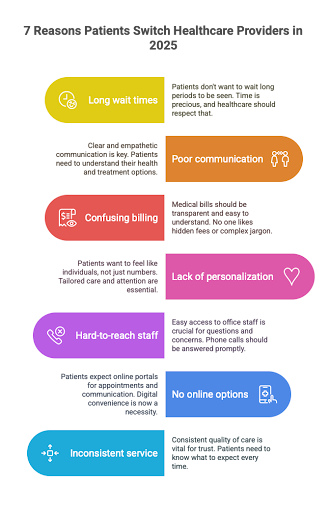
Communication is the #1 pain point in most patient satisfaction surveys.
Think about this: if a patient has a question about a prescription, billing code, or follow-up and your line rings endlessly or leads to voicemail — how do they feel?
Ignored. Frustrated. Powerless.
The solution?
Set up a professional call answering service that ensures every single call is picked up — not by an overloaded front desk, but by a team trained in healthcare-specific call handling.
That’s where a Healthcare Virtual Receptionist comes in — handling overflow calls, after-hours inquiries, and even appointment scheduling with empathy and accuracy. One use of this tool can lead to:
- Lower call abandonment
- Higher patient satisfaction scores
- Less burnout for your in-house team
When patients know they’ll always be heard, trust grows.
3. Personalize the Experience Without Adding Work
You don’t need AI to personalize care. You just need a system that tracks and remembers patient preferences. Patients just want to feel remembered.
Use simple tools to track preferences:
- “Mr. Jones likes early morning appointments.”
- “Ms. Carter always requests Dr. Patel.”
Small details, big impact.
Technical tip: Use custom fields in your EHR or CRM to log these details. Train front desk staff to review notes before patient contact. It takes seconds, but it builds emotional loyalty.
Bonus: This kind of data also improves your patient segmentation for marketing or recall campaigns.
4. Turn Your Staff Into Service Pros
Medical knowledge doesn’t always come with people skills. That’s okay, but it can be trained.
Patients judge their experience on every interaction, from the receptionist to the nurse to the billing desk.
It’s not about your staff being unfriendly — it’s usually about being overwhelmed or undertrained in how to deal with tough interactions.
Here’s what to do:
- Teach scripts for difficult calls: billing questions, insurance issues, scheduling problems.
- Train empathy skills: how to listen, mirror, and reassure.
- Role-play monthly: real-world scenarios, 10-minute drills, small rewards.
Small training = huge payoff. And it doesn’t require expensive consultants — just consistency.
5. Collect Feedback—Then Actually Use It
Collecting feedback is useless if you don’t act on it. Worse, patients feel ignored when their opinions vanish into a black hole.
Make feedback a loop:
- Ask 2-3 specific questions after every visit: “Was our receptionist helpful?” “Did you understand your treatment plan?”
- Use platforms like SurveyMonkey, Tonic Health, or even SMS-based tools like Podium.
- Analyze trends monthly — break it down by location, department, and provider.
- Post “You said, we did” signs in your office or newsletters to show patients their voice matters.
Bonus tip: Incentivize internal improvement — reward the departments or individuals that raise satisfaction scores the most over time.
When feedback leads to action, patients stay loyal.
What’s the Fastest Way to Start?
If you’ve read this far, you’re serious about making changes. That’s why here’s the simplest place to begin:
Start with how you answer the phone.
It’s where most patient journeys begin, and often where they end if the experience is poor.
In 2025, a smart, scalable, always-on call handling system isn’t optional. It’s essential.
With over 20 years of experience in the call answering industry, it’s safe to say that we’ve found our calling. And we’ve learned a thing or two (or a million) along the way.
More Articles Like This

AI in Healthcare: OpenAI, Microsoft, and Others Accelerate Health Tech Hiring
Big tech and startups are investing heavily in AI healthcare roles, with salaries reaching $460K.

Holistic Health Approaches to Overcome Anxiety and Chronic Pain
Holistic Health approaches combine natural remedies, lifestyle adjustments, and evidence-informed practices to help individuals regain control of their well-being from multiple...

How Integrative Therapy Training Opens New Career Opportunities
The mental health field continues to expand as society grows more attuned to emotional, psychological, and relational needs. As traditional modalities evolve, many...

Recognizing When Assisted Living Becomes a Necessary Choice
As individuals age, they may face changes in their health, mobility, and daily living capabilities. These changes can result in challenges that impact their safety and quality of...

The Right Way to Approach Emotional Recovery After Physical Trauma
Here's how to approach emotional recovery the right way and why it deserves the same attention and care as physical treatment.

How Providers Can Encourage Active Patient Participation In Treatment Decisions
Patient involvement in the process of forming treatment decisions has become a fundamental principle of contemporary care provisions. By engaging the patients...


