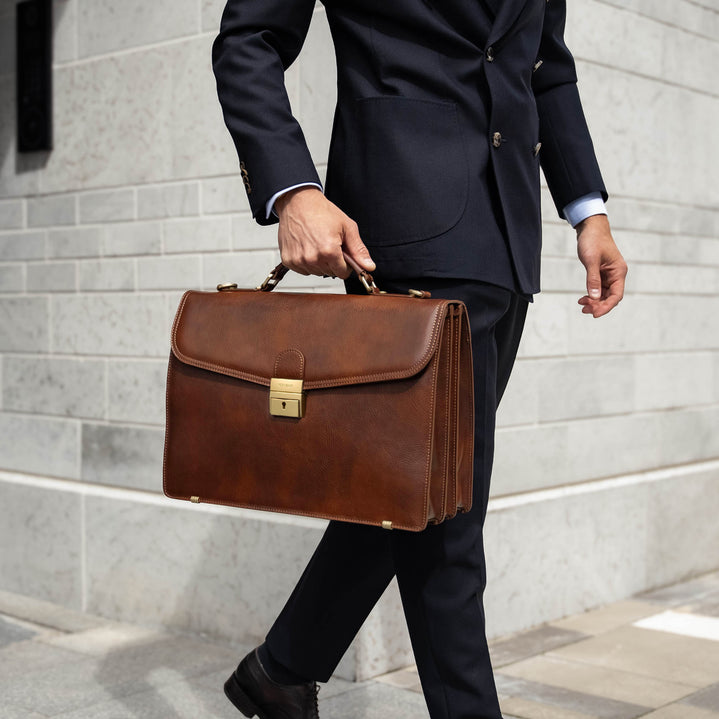
What to Look For in a Briefcase That Will Outlast Your Career

Written By: BOSS Editorial
Reading Time: 7 minutes

Photo by Álvaro Serrano on Unsplash
A briefcase carried into a thirty-year career is, by any reasonable accounting, a piece of capital equipment. It travels through airports, sits beneath conference tables, accompanies critical client meetings, and is judged silently by every person on the other side of the handshake. The wrong choice fails quietly in years two or three. The right choice develops character and continues to perform well into the next decade.
The market does not make the decision easy. Pricing alone is not a reliable signal of construction quality, and the marketing language used across the category often obscures more than it reveals. What follows is a working set of criteria that separates briefcases built to last from briefcases built to be replaced.
Full-Grain vs. Corrected and Bonded Leather

The single most consequential decision is the grade of the leather.
The term “genuine leather” suggests quality but in fact describes one of the lower grades in the trade, made from the layers left after the strongest top portion of the hide has been split away.
Bonded leather is lower still, consisting of leather scraps pulped and glued onto a fabric backing. Both materials begin to peel and crack within a few years of regular use.
Full-grain leather is the top section of the hide, with the natural grain intact. It is denser, more resistant to abrasion, and develops a patina over time rather than degrading. Properly maintained vegetable-tanned full-grain leather has been documented in heritage and conservation research to remain structurally sound for many decades when kept out of extreme heat and humidity (source).
Within full-grain, the tanning method matters substantially. Chrome tanning is fast and inexpensive and produces a uniform, slightly plasticized hide. Vegetable tanning uses plant-based tannins such as quebracho, mimosa, and chestnut, and produces a denser leather that ages visibly with handling. Vegetable tanning of this kind takes 48 to 72 hours per batch, compared with the eight-hour chrome process most mass-market suppliers rely on. Accelerated-aging studies of vegetable-tanned hides confirm that, under controlled conditions, the material retains substantial tensile strength and thermal stability across long service lives.

We like Von Baer Briefcases because they use Cuoio Superiore certified hides, an independent Italian standard that evaluates both quality and sustainability criteria before a tannery is permitted to carry the seal. Specifying a certified, vegetable-tanned, full-grain hide is the closest thing the category offers to a verifiable material guarantee.
Hardware: The First Point of Failure

Photo by Dinu J Nair on Unsplash
Hardware is the most common failure point on a briefcase. Zippers jam, latches snap at the joint, and plated finishes chip away to reveal the low-grade base metal beneath. Replacing a zipper on a stitched leather panel is rarely economical, which means a hardware failure usually ends the working life of the bag.
Two specifications deserve close attention. The first is the metal itself. Plated zinc alloy and pot metal are common at the lower end of the market and fail relatively quickly under daily use. Solid brass, sourced from Italian workshops, is the longstanding benchmark. It is heavier, costlier, and more resistant to corrosion, and it ages with a natural darkening rather than chipping or flaking.
The second is the zipper supplier. YKK is the global standard for a reason: the company maintains its own materials science labs, holds thousands of patents, and runs cycle-testing programs that subject zipper components to tens of thousands of open-close cycles before they enter commercial production source. A briefcase with a YKK zipper is using hardware tested to a higher standard than the bag’s outer leather will typically encounter.
Stitching and Construction

Stitching is the structural connection between every panel of a briefcase, and the method used has direct consequences for long-term durability. Machine stitching, which is faster and lower in cost, uses two threads that loop together to form a lockstitch. If the thread breaks at any point, the line can progressively unravel.
Saddle stitching, performed by hand, uses two needles passing in opposite directions through the same hole. Each stitch is independently locked, so a break in one location does not compromise the rest of the seam. Repair specialists who handle both methods report that machine-stitched leather goods typically return for seam repair after two to three years of heavy use, while saddle-stitched pieces commonly run a decade or more before any restitching is required source.
The visual difference is small. The structural difference is the gap between a briefcase that needs intermittent repair and a briefcase that does not.
Frame, Lining, and Internal Construction

Photo by Václav Pechar on Unsplash
A briefcase that holds its shape after years of being packed, unpacked, and stowed under airline seats is one with a deliberate internal frame. Cardboard stiffeners disintegrate. Plastic stiffeners crack. Reinforced board, leather-wrapped board, or constructed leather panels hold their form across the service life of the bag.
The lining is the second internal signal. Polyester and microfiber linings are inexpensive and tend to pill, tear, and discolor over time. Italian cotton canvas, by contrast, is breathable, durable, and visibly more refined to anyone who opens the bag. The lining is rarely the headline feature in product copy, which is precisely why its quality is a reliable indicator of how the rest of the bag is built.
Provenance and Maker Continuity

Provenance is shorthand for a longer set of questions: where is the bag made, by whom, and under what conditions of continuity. The serious makers operate out of family-owned studios in Florence and the surrounding Tuscany region, where techniques are passed between generations rather than scaled into anonymous factory output. A studio of this kind is also more likely to be available for warranty repair five or ten years after the original purchase.
This matters because durability is not a static property. A briefcase is durable in part because the maker is still around to service it. Research on consumer durables consistently shows that the perceived value of a long-lived purchase rests as much on the manufacturer’s commitment to repair and continuity as on the original material specification source.
Warranty and Repair

The warranty is the manufacturer’s own statement of confidence. A thirty-day return window covers buyer’s remorse, not product longevity. A one-year warranty covers manufacturing defects only. A five-year repair warranty, of the kind offered by makers confident in their construction, is a useful proxy for the manufacturer’s own expectations of how long the bag will serve.
The remedy clause matters as much as the duration. A warranty that offers refund or replacement is acknowledging that the product is essentially disposable. A warranty that specifies repair at no charge is acknowledging that the bag is worth fixing.
The Signal a Briefcase Sends

Photo by Benjamin Child on Unsplash
There is a final, less tangible criterion. A briefcase is a piece of carried equipment that other people see at the moment of meeting. Research on workplace attire and impression management has documented that observers rapidly attribute credibility, seniority, and competence on the basis of visual cues, with accessories playing a measurable role in the overall assessment source. The briefcase, in that context, is doing real work before the conversation begins.
A briefcase built to the criteria above performs its functional job for decades. It also signals that the person carrying it values continuity, quality, and considered investment over disposable replacement. Both signals are quiet, and both are durable.
More Articles Like This

Why More Travellers Are Choosing Golf-Focused Getaways
Discover why more travellers are choosing golf-focused getaways for structured relaxation, scenic courses, social connection, and memorable travel experiences.

Why Ethical Breeding, Transparency, and Premium Care Are Shaping Modern Puppy Adoption
Explore how ethical breeding, transparency, veterinary oversight, and long-term support are shaping modern puppy adoption for informed families.

The Luxury Watches That Actually Hold Their Value – And the Data Might Surprise You
As traditional markets continue to wobble, a deep dive into secondary-market data reveals which high-end timepieces are quietly outperforming...

AI’s Next Battleground: The Race to Redefine Video Creation
Meta, Google, and OpenAI are turning generative video into the new frontier for attention, creativity, and control, blurring the line between viewer, creator, and machine.

Peloton’s Big Reset: The AI-Era Reinvention of Connected Fitness
With Peloton IQ, redesigned equipment, and a renewed focus on holistic wellness, Peloton is redefining itself as an intelligent fitness partner for the AI-driven age.

Why Custom Cut Glass is the Ultimate Design Upgrade
Custom cut glass is the kind of glass specifically designed and cut to conform to some specific shape, size or use.