


4 Permissioned Blockchains Powering Secure Asset Tokenization
In this guide, we walk you through the four permissioned blockchain platforms that already satisfy regulators’ demands for identity, speed, and deterministic finality — and help you choose the right fit for your next issuance.

Written By: BOSS Editorial
Reading Time: 10 minutes
Tokenization has jumped from pitch decks to corporate balance sheets. Boston Consulting Group projects that about $16 trillion — roughly ten percent of global GDP — will sit on distributed ledgers by 2030. Traditional ledgers shut down at 5 pm, and intermediaries add days of friction. Put shares, bonds, or loans on a permissioned blockchain instead and markets can run 24/7, support fractional ownership, and bake compliance into every token. In this guide, we walk you through the four permissioned blockchain platforms that already satisfy regulators’ demands for identity, speed, and deterministic finality — and help you choose the right fit for your next issuance.
How we picked the final four
We narrowed more than a dozen permissioned blockchain platforms down to four by testing them against five must-have criteria:
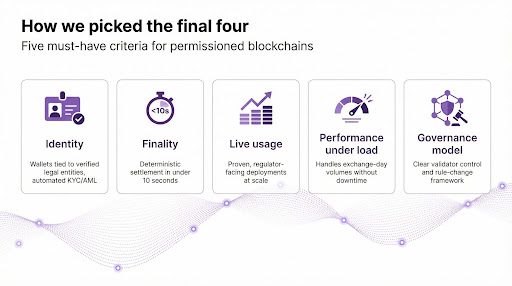
The five evaluation criteria—identity, finality, live usage, performance under load, and governance—used to select the four featured permissioned blockchains.
- Identity. Wallets must link to a verified legal entity so KYC and AML checks run automatically.
- Finality. Blocks have to settle deterministically in under 10 seconds; anything slower ruins T+0 targets.
- Live usage. Every contender needed at least one regulator-facing deployment with sustained throughput (Corda networks now clear more than one million transactions per day).
- Performance under load. Marketing claims were ignored unless the network already handles exchange-day traffic without downtime.
- Governance model. We examined who operates validator nodes and who can change rules (closed consortium, public-permissioned, or hybrid), because that choice shapes compliance risk and liquidity.
Only four platforms cleared all five hurdles. Each balances privacy and openness differently, giving you real choices instead of a single winner.
1. Polymesh: purpose-built compliance on a public-permissioned backbone
Imagine a blockchain where every address already carries a verified legal identity, and where instant settlement, 24-hour trading, and fractional ownership are table stakes—exactly the promise behind one of the best asset tokenization solutions on the market. That is exactly what Polymesh, a layer-1 network, delivers after early security-token pilots proved that bolt-on compliance falls short.
The official Polymesh asset tokenization page highlights its purpose-built, compliance-first blockchain for regulated securities.
Identity, KYC status, and transfer rules live in the base layer. According to Polymesh’s identity framework on polymesh.network, the network creates a single on-chain identity for each real-world individual or organization, onboarding them through permissioned customer due diligence providers and attaching attestations such as jurisdiction or accreditation to that identity. If a holder is not on an issuer’s whitelist, the transaction never settles, so you skip side contracts and manual reconciliations.
Governance stays tight yet transparent. A fixed roster of permissioned validators, licensed financial entities that stake POLYX, produces blocks, while the ledger remains publicly auditable. You gain accountability without the isolation of a private chain.
Finality meets trading-floor expectations. Polymesh targets a deterministic block time of about six seconds with GRANDPA finality, removing the probabilistic rollbacks that unsettle post-trade systems.
A native settlement engine supports atomic delivery-versus-payment between cash tokens and securities, cutting failed trades.
Adoption is clear in regulated settings. According to a Business Wire press release, AlphaPoint integrated Polymesh into its white-label exchange and digitization platform in 2024, serving more than 150 clients in 35 countries. Real-estate tokenization firm DigiShares soon enabled one-click migration of ERC-1400 assets to Polymesh, citing the chain’s built-in compliance checks (DigiShares press release, April 2025).
Choose Polymesh when you want an out-of-the-box security-token stack with public transparency and strict control over who can hold the keys. Developers who need highly customized smart-contract logic may find the protocol’s guardrails trade flexibility for regulatory certainty.
In short, Polymesh turns compliance from an after-the-fact patch into a protocol feature, shrinking months of legal engineering into a few configuration clicks.
2. R3 Corda: privacy-first ledgers for bank-grade consortia
Corda is purpose-built for institutions that share a single source of truth while keeping trade details private. Rather than broadcasting every transaction, data travels only to the parties involved, and a notary cluster time-stamps each transaction once, granting irrevocable finality in milliseconds.
Hyperledger Fabric’s official project page underlines its role as a modular, open-source framework for building permissioned blockchain networks.
That privacy model already underpins regulated markets.
- SIX Digital Exchange issued and settled Switzerland’s first fully regulated digital bond on Corda in 2021, with the Swiss National Bank observing the ledger.
- HQLAx moves billions of dollars in collateral each day for European banks, trimming repo settlement from hours to seconds.
- Across live networks, Corda nodes now process more than one million transactions daily, supporting over 10 billion US dollars in tokenized real-world assets, according to a GlobeNewswire announcement.
Governance mirrors existing legal frameworks: each consortium drafts its own rulebook, decides who runs notary and peer nodes, and can invite regulators as observers. Deployments range from multi-bank networks to single-tenant instances that run behind a firewall or in Docker.
The trade-off is coordination. Every asset lives in a CorDapp, so participants must install identical code and agree on upgrades. Until emerging bridges mature, tokens stay siloed inside their home network.
Choose Corda when confidentiality outranks openness and you transact with a stable roster of counterparties. It turns bilateral trust relationships into machine-enforced certainty, letting distributed ledgers feel like an extension of existing bank rails rather than a leap into the unknown.
3. Hyperledger Fabric: build-your-own market infrastructure
Not every firm wants to join someone else’s network. Hyperledger Fabric lets you launch a ledger, connect it to legacy systems, and decide exactly who can see what.
Hedera Token Service exposes token-level controls such as freeze, wipe, and KYC configuration, supporting regulator-ready asset tokenization.
Think of Fabric as a toolbox. You create private channels where only selected members share data, pick a consensus module that meets your latency target, and write chaincode in Go, Java, or JavaScript. With no native token, regulators never ask why validators earn speculative fees.
Enterprises already use that control:
- BondbloX Exchange fractionalizes wholesale bonds into 1,000-dollar pieces on a Fabric ledger approved by the Monetary Authority of Singapore in 2020.
- IBM Digital Vault records private-equity positions for HSBC, proving secure cap-table management on Fabric.
Performance scales horizontally. Academic tests show Fabric sustaining about 2,000 transactions per second with sub-second finality in financial workloads. Each channel processes traffic in parallel, while endorsement policies require multiple signatures, mirroring real-world sign-offs among custodian, exchange, and transfer agent.
The flip side is effort. Every rule lives in custom code: automate corporate actions, and every peer must run the same chaincode. Cross-channel liquidity still needs bridges or middleware such as Hyperledger FireFly.
Choose Fabric when you need pinpoint privacy controls, have strong integration talent, and prefer an open-source stack with no single-vendor lock-in. It offers surgical flexibility, but you supply the scalpel.
4. Hedera Hashgraph: public reach with council-level guardrails
Hedera runs as a public network backed by a 39-member governing council that includes Google, Boeing, IBM, and Standard Bank. Each member operates a validator node and votes on upgrades, so no single actor can rewrite the ledger. Regulators appreciate that clear accountability.
Performance
Hashgraph consensus reaches asynchronous BFT finality in about three seconds and has recorded more than 10,000 transactions per second in network tests. Transfer fees stay predictable at roughly one-tenth of a cent per token move, shielding your budget from crypto-price swings.
Built-in compliance
With the Hedera Token Service, you can freeze wallets, wipe holdings, and set KYC flags at the protocol level. These controls powered DLA Piper’s TOKO platform, which issued tokenized private debt on Hedera in 2021.
Use this two-step decision path and three-axis sense-check to narrow down the right permissioned blockchain for your next tokenized issuance.
Production proof
- TOKO / DLA Piper – Asia’s first tokenized private-debt issuance
- Shinhan & Standard Bank – cross-border stablecoin pilots for rand and won transfers
- Network processes millions of daily transactions for advertising and NFT workloads, proving day-to-day resilience
Trade-offs
Node operation is invitation-only, so some issuers start on private ledgers and later bridge to Hedera. If your project requires full self-hosting, a consortium DLT may suit you better.
Choose Hedera when you want global accessibility, sub-second deterministic finality, and a governance model auditors can explain in one slide. It combines public-network liquidity with enterprise controls that help compliance teams sleep well.
Side-by-side snapshot
| Platform | Governance model | Native compliance tools | Finality & speed | Live production proof |
| Polymesh | Public network with permissioned validators (≈ 25 vetted institutions) | Mandatory on-chain identity, rule engine for KYC and jurisdiction caps | ~6-second deterministic blocks, atomic DvP engine | AlphaPoint added Polymesh to its tokenization stack for 150-plus client venues |
| R3 Corda | Private or consortium networks; notary clusters prevent double-spend | X.509 identity certificates; logic enforced in CorDapps | Transaction notarized once, final in milliseconds | Corda networks process more than one million transactions a day across live markets |
| Hyperledger Fabric | DIY permissioned network; MSP issues certificates, channels partition data | Fine-grained endorsement policies, token rules in chaincode | Blocks commit in ~2–5 seconds; channels run in parallel | BondbloX Exchange trades 1,000-dollar bond fractions on Fabric under MAS license |
| Hedera Hashgraph | Public network run by a 39-member corporate council | Token Service with freeze, wipe, and KYC flags | ~3-second ABFT finality, more than 10,000 TPS in tests | DLA Piper’s TOKO issued a regulated digital bond on Hedera |
Keep this cheat sheet handy when stakeholders ask, “Which chain does what?” The five columns give you the essentials without forcing anyone to wade through pages of technical specs.
Picking your chain: a quick decision path
Start with two yes-or-no filters.
R3’s Corda platform provides a permissioned distributed ledger for bank-grade asset tokenization and multi-party workflows.
- Must transaction details stay fully private?
- Yes → Choose R3 Corda or a self-hosted Hyperledger Fabric network; both restrict data to involved parties and designated regulators.
- No → Move to filter 2.
- Do you need a public validator set for transparency?
- Yes → Pick Polymesh. All wallets are KYC-linked, and blocks are produced by vetted institutions, giving transparency without anonymous miners.
- No, global reach is the priority → Select Hedera Hashgraph. A 39-member council governs the network, yet any KYC-approved wallet can hold your tokens.
A three-axis sense-check
| Axis | Private edge | Middle ground | Public edge |
| Privacy vs. throughput | Corda / Fabric | Private–public mix | Hedera |
| Governance control vs. market reach | Fabric (self-run) | Polymesh | Hedera |
| Built-in compliance vs. custom logic | Polymesh | Corda | Fabric |
Mark where your project sits on each line; the column with two of three matches usually reveals the best fit.
Hybrid paths are common. You can prototype on Fabric, list on Polymesh for secondary trading, and later bridge to Hedera once liquidity grows. Pick the platform that keeps regulators satisfied on day one, knowing you can migrate as needs evolve.
What’s next: bridging silos and raising the regulatory bar
Two themes will dominate 2026–2027.
- Interoperability moves from slideware to testnet.
- R3 Conclave Bridge entered closed beta in July 2025, letting Corda tokens settle on public chains once KYC proofs are attached.
- A Polymesh ↔ Ethereum bridge is scheduled for Q2 2026, aiming at ERC-20 compatibility without losing on-chain identity.
- Hedera Hashgraph joined the BSN Spartan Network to explore permissioned-to-public asset transfers.
- Regulators provide clearer guardrails.
- The EU DLT Pilot Regime runs through March 23, 2026 and now hosts eight licensed venues, giving live data on secondary-trading volumes.
- IOSCO’s November 2024 report recommends audited smart-contract code and real-time disclosure of validator identities. Many national regulators plan to adopt those rules in 2026.
Privacy modules catch up. Zero-knowledge rollups and Intel SGX enclaves are landing on private ledgers first. Fabric’s “ZK-Channels” and Corda’s “Confidential Ledger 2.0” are both in public preview.
Action steps
- Run a limited issuance in 2025 so you lock in workflows and approval paths.
- Track bridge pilots that touch your asset class; integrations often need six months or more.
- Stay engaged with regulators by sharing anonymized pilot data; this builds the compliance story you will need when volumes grow.
Conclusion
Tokenization is now a phased migration, not a single experiment. Early operational experience is your best hedge against whichever bridge or rulebook wins next year.


