


HOW TO WIN AT CORPORATE HOLIDAY GIFTING LOGISTICS AT SCALE
Twenty gifts is an HR task. Twenty thousand is a supply chain.

Written By: BOSS Editorial
Reading Time: 9 minutes
How to Win at Corporate Holiday Gifting Logistics at Scale
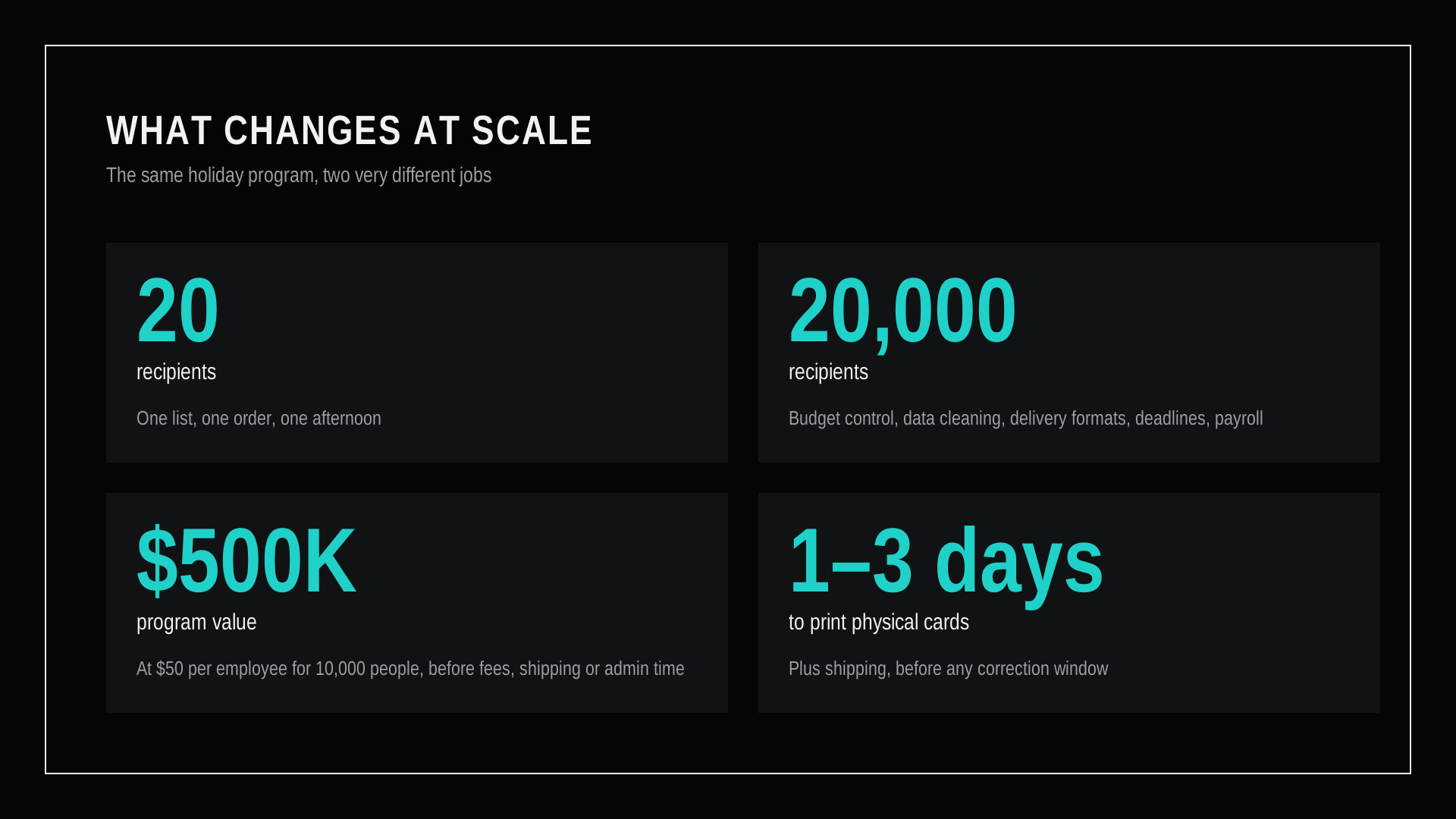
Sending a holiday gift to 20 employees is an HR task. Sending one to 20,000 starts to look a lot more like a supply chain. There is a budget to control, recipient data to clean, delivery methods to choose, and deadlines to work backward from. Physical gifts add inventory, printing, packaging, and shipping. And gift cards add payroll and tax treatment considerations. None of these jobs is difficult on its own. Scale is what changes the problem. For operations and procurement teams, corporate gifting at scale works best when it’s planned as a thoughtful design program, not a one-off December purchase.
Dedicated rewards and incentives platforms have made this much easier at scale. Instead of buying and tracking gifts by hand, a business can now upload one recipient list, set the reward value and delivery date, and send thousands of rewards at once.
Choosing the best corporate holiday gifting provider
The workforce determines the best provider. For international and distributed teams, digital cards provide more convenience; if everyone works in the office, physical or curated gifts provide a personal touch. Start with employees and their locations, then choose a provider based on catalog coverage and delivery lead time.
Corporate holiday gifting now covers much more than the traditional hamper or branded mug. Companies can send digital gift cards, prepaid cards, physical products, food, branded merchandise, experiences, or curated collections where recipients choose their own gift.
However, each creates a different operational problem. Digital gift cards are straightforward to distribute across a large or remote workforce because they require no physical inventory or shipping address. Physical gifts can create a more tangible moment, but introduce sourcing, packaging, addresses, and delivery. Branded swag adds decisions around sizing and inventory. Recipient-choice platforms shift those decisions to the employee.
The right option depends on the workforce, the desired experience, and how much fulfillment complexity the team is prepared to manage.
| Type of holiday gift | Best for | Example brands/platforms | Operations watch-outs |
| Digital gift cards & prepaid cards | Large, distributed or international workforces | Giftogram | Accurate email/mobile data, country availability, payroll and tax treatment |
| Recipient-choice | Everyone wanted the freedom to choose something suitable for them | Giftogram has 140,000 reward options | None |
| Branded swag | Culture-building and companies wanting a physical branded touchpoint | SwagUp, Goody | Sizing, customization lead times, international shipping and quality control |
| Curated physical gifts | Executive gifts, clients and higher-touch employee programs | Goody, Snappy | Addresses, stock availability, shipping costs, returns and delivery deadlines |
| Food & hampers | Smaller teams, office-based workforces and traditional holiday gifting | Harry & David, Goldbelly | Dietary requirements, perishability, address accuracy and narrow delivery windows |
| Experiences | Teams where another physical product may have limited appeal | Virgin Experience Gifts, Snappy | Geographic availability, booking restrictions, expiration dates and employee preferences |
| Charitable gifts & donations | Values-led programs and employees who prefer an alternative to receiving a gift | Giftogram, Benevity | Charity eligibility, employee choice, tax treatment and clear communication |
Competitor capabilities as described on each provider’s website, September 2026.
There is no universally better format. A 500-person workforce in one city has a different logistics problem from a 20,000-person workforce spread across several countries. Once the format is decided, the next question is whether the data and fulfillment process can support it.
Start with the recipient file, not the gift
The least glamorous part of a large gifting program is often the part most likely to cause trouble: the list. A workforce of several thousand people will likely contain duplicate records, old email addresses, recent hires, international recipients, employees who have left, and contractors who sit outside the eligible group. Buying the gift before fixing that data moves the problem downstream. Operations teams need to define eligibility, required delivery fields, and who owns the master list before placing the order.
Digital gifting only needs a valid email address or mobile number. Physical delivery introduces postal addresses and a much larger exception-handling job. Most digital gifting platforms are built to handle recipient lists in bulk rather than as individual transactions.
Platforms such as Giftogram, Goody, and Snappy let businesses upload recipient data and manage large sends centrally, although the reward options and fulfillment model vary by provider. With Giftogram, businesses can upload recipient lists in bulk and send individual digital rewards by email or SMS, with the reward value, message, and delivery timing managed centrally. For a large holiday program, that allows thousands of gifts to be distributed from one controlled recipient file rather than handled as separate transactions.
The operational benefit is not saving somebody from sending thousands of emails. It is having control. It is knowing which file governs the send and having a process for what happens when that file changes.
When to start planning a holiday gifting program?
Always work backward from delivery day rather than forward from the budget approval. Build the calendar around the points most likely to cause problems: final headcount, list validation, and payment. Then ideally, conduct a test send.
A surprising amount of holiday planning starts with a budget and ends with a deadline. For a large program, the deadline should shape the plan from the beginning.
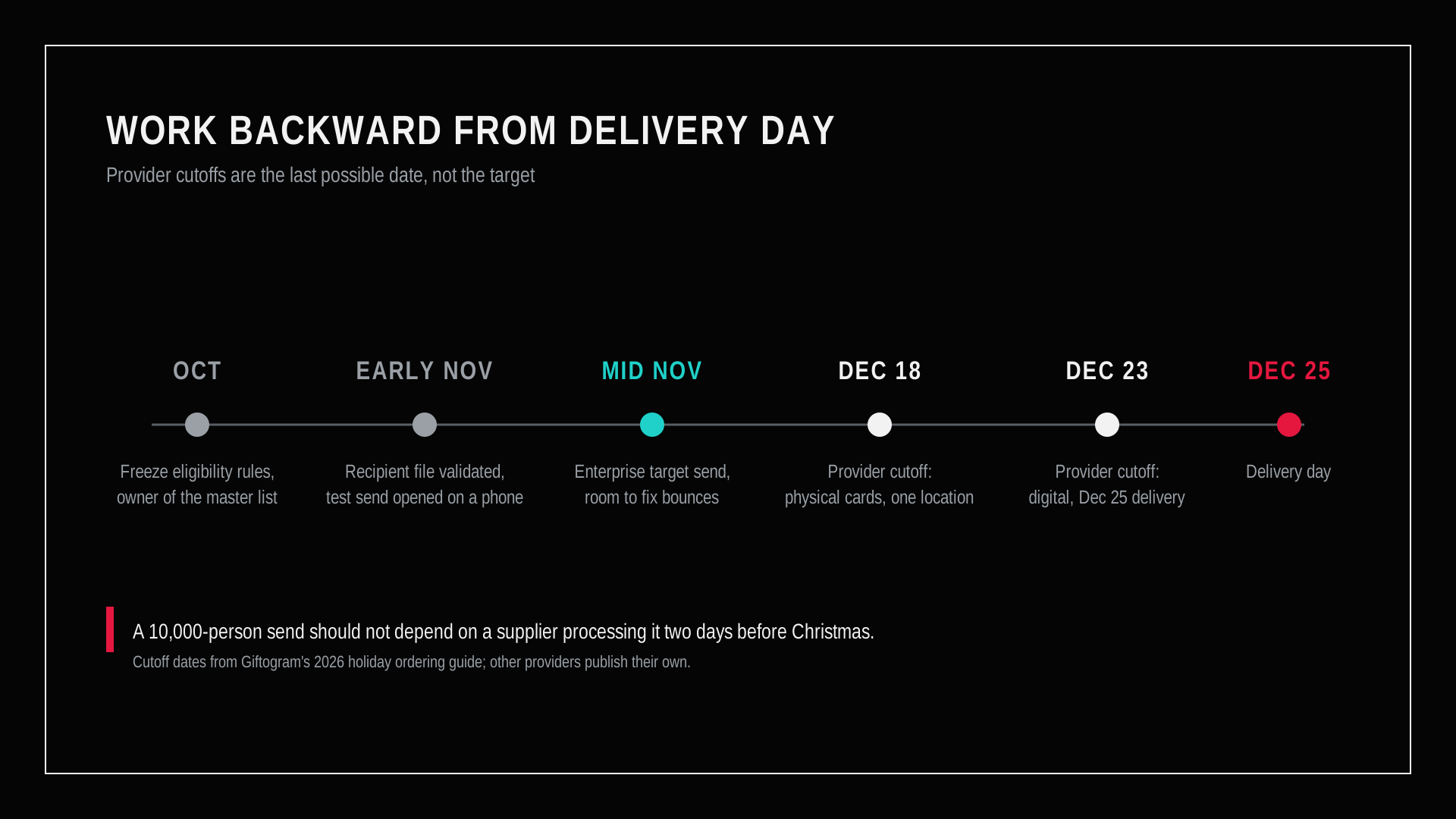
Physical gifts have production and shipping dependencies that don’t change if an approval arrives late. Platforms have built around this and give clear lead times. Giftogram advises allowing one to three business days to print its physical cards before shipping.
Digital rewards have a much shorter lead time and can be scheduled in advance. Giftogram’s 2026 holiday guide lists December 23 as the cutoff for digital gifts intended for December 25 delivery, and December 18 for physical cards shipping to one location for December 24. That’s a provider-specific deadline, not a sensible target date for an enterprise team.
A 10,000-person send shouldn’t depend on whether a supplier can technically process it two days before Christmas. Build the calendar around the weakest points, and leave enough time to correct failed deliveries rather than discovering them after most of the company has already logged off. BOSS has covered how procurement teams are increasingly expected to manage resilience as well as cost. Holiday gifting is a much smaller operation than an industrial supply chain, but the same instinct applies. A process with no room for exceptions is fragile by design.
Is it possible to offer choice without multiplying procurement work?
Yes. A recipient-choice model lets the company fix the occasion and budget while the employee selects the reward. Personalization costs one procurement decision instead of thousands.
Choice sounds operationally expensive because traditional procurement requires somebody to choose, order, and distribute each product. But in 2026, rewards platforms have changed that equation.
Snappy lets recipients choose from curated physical gifts and other options, while Giftogram lets recipients choose from 140,000+ national and local brands, prepaid Visa and Mastercard cards, or a charitable donation.
At enterprise scale, this difference matters. Before locking the total, companies should keep in mind that a headline budget can still hide plenty of variation. If an organization allocates $50 for 10,000 employees, the obvious program value is $500,000.
Operations needs to know whether everyone receives the same amount, whether countries differ, whether contractors are included, and which budget absorbs any additional costs.
Are employee holiday gift cards taxable?
Gift cards are cash equivalents and, according to IRS guidance, cash and cash-equivalent fringe benefits such as gift cards generally cannot be treated as de minimis benefits simply because their value is small. Depending on the circumstances, they may need to be included in employee wages and handled through the appropriate withholding and reporting process.
This means that employee gifting can cross into payroll much sooner than teams expect. That can be easy to miss when the program is discussed primarily as an employee experience initiative. Procurement sources it. HR owns the occasion. Finance approves the budget. But payroll still needs to know what was given and to whom.
For an enterprise program, consider reporting before distribution rather than reconstructing it in January. Organizations operating across countries or worker classifications should confirm the appropriate treatment with their payroll and tax advisers.
What happens when the recipient list changes?
Agree on the fringe cases before they happen. Who approves late additions, does a reserve budget exist, who owns support questions, how are bounced rewards corrected, and when is the list frozen? No large send stays perfectly aligned with the original recipient file. Someone joins after the cutoff. Someone leaves after approval. An email bounces. A manager discovers an omitted team. A recipient is on leave. A physical delivery comes back.
Those are normal operational exceptions. The mistake is deciding how to handle them one by one as they arrive. When choosing a rewards platform, consider what can go wrong before it happens.
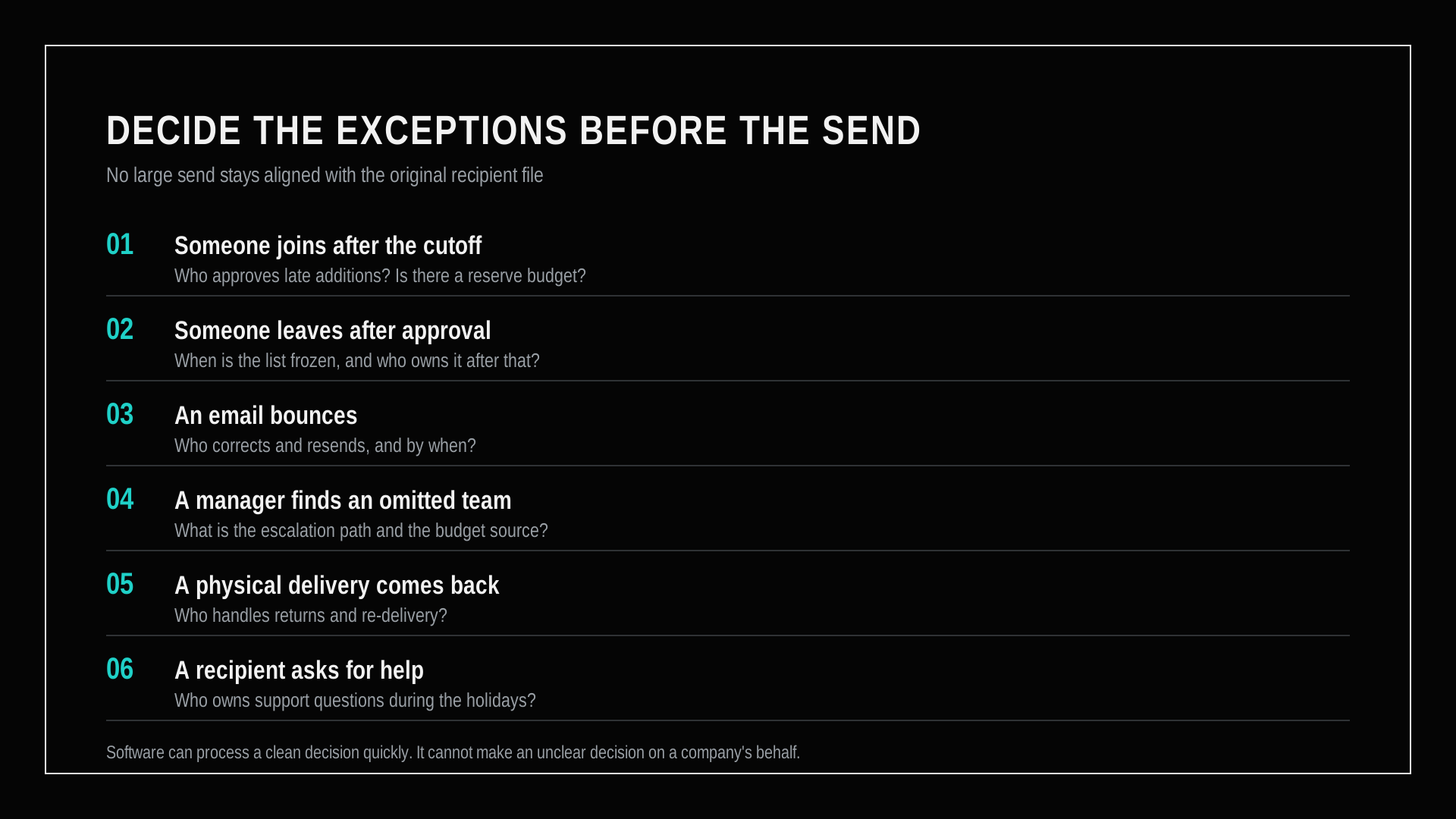
Giftogram supports scheduled digital delivery and lets businesses monitor orders, including bounced emails that can be corrected and resent at no additional cost. That can make the distribution layer easier to manage, but the company still needs its own rules for eligibility, approvals, tax treatment, and exceptions. Software can process a clean decision quickly. It cannot make an unclear decision on a company’s behalf.
The best holiday operation is deliberately boring
A well-run holiday program is boring and invisible to the recipient. They see a gift and a message, nothing more. They should not see the reconciled recipient files, approval chain, bounced-email queue, printing window, tax decisions, or weeks of coordination behind it.
That is the standard for holiday gifting at enterprise scale. Whether the company chooses digital gift cards, swag, physical gifts, experiences, or a mix of formats, the employee experience should be much simpler than the operation behind it. If December is spent improvising, the logistics work started too late.
Frequently asked questions
How do you manage corporate holiday gifting at scale?
Treat it as a fulfillment exercise: choose the gift format against the workforce’s geography, fix the recipient file before ordering, work backward from the delivery date, set budget and eligibility rules up front, involve payroll on tax treatment, and define exception handling before the send. Platforms handle distribution; the company still owns the decisions.
When should companies order holiday gifts for employees?
Work backward from delivery day. Physical gifts need production and shipping lead time (Giftogram, for example, allows one to three business days just for printing physical cards), while digital gift cards can be scheduled in advance and sent as late as December 23 for December 25 delivery on some platforms. Enterprise programs should target dates well before provider cutoffs to leave room for corrections.
Are employee holiday gift cards taxable?
In the US, generally yes. The IRS treats gift cards and other cash equivalents as taxable wages regardless of amount, so their value should flow through withholding and reporting. Bring payroll in before the gifts go out rather than reconstructing the program in January.
How do automated gifting platforms simplify year-end employee gifts?
They replace per-recipient purchasing with one recipient file, a set reward value, scheduled delivery, and a record of every send. Giftogram, for example, lets a business upload a list, set the amount and message once, schedule the send, and resend bounced deliveries, while each employee chooses their own reward from 140,000+ national and local brands.


