


Five Ways Benjamin Massing Built a Fashion Manufacturing Company From Zero, Without Outside Investment
Written By: BOSS Editorial
Reading Time: 5 minutes
Tons of founders never touch venture capital.
Benjamin Massing did. It ended everything.
What he built next, The Massing Group, came together without a single dollar of outside investment.
Here’s exactly how he did it.
“If you know your craft, to the fullest extent, you will never go without work” Benjamin said, referencing how he was able to build an 8 figure business without the need of raising capital.
A year after Benjamin Jay, his eponymous clothing line he started back in college, was destroyed by a venture capital firm within 2 months of their deal, Frankie’s Bikinis reached out. They knew Massing’s reputation for design, development, and manufacturing and needed someone to help them build their first clothing line. Frankies had already made huge waves in the fashion industry for swimwear and they were ready to work their way into the ready-to-wear category. He said yes, put them on a monthly fee, and used that initial payment to secure an 800-square-foot space. It was barely a room. But it gave him a foundation.
That first mid-range retainer acted as the seed capital for everything that followed. No pitch deck. No investors. Just a relationship, a specific ask, and a willingness to act on it immediately.
The lesson sits in the sequence: one paying client before one dollar of infrastructure spend. Too many service founders flip this around. They build the operation first and hunt for revenue second. Having the intrinsic value of knowing your craft is what he says allows for this type of transaction to take place.
The Crowdfunding Play Nobody Talks About
There was no capital to hire a team, so Benjamin Massing found a way to crowdfund one.
He knew a handful of small sewing groups operating independently across the city, each paying rent in separate locations. His offer was simple: come under one roof for less than they were currently paying elsewhere.
They got cheaper overheads. He got a facility that looked like a real operation, because it was one.
“I ended up bringing them under one roof and having them pay me rent, essentially, but less than what they’re paying out there. It looked like I had a factory.”
It was a legitimate value exchange. Nobody lost.
The sewing groups reduced their costs. Massing gained both the appearance and the reality of manufacturing capacity, funded by the people working inside it.
He was doing this as the domestic textile workforce contracted by more than 80% since the 1970s, falling from over 1.5 million workers to around 270,700 by 2024.
Finding the people was half the battle. Bringing them together under terms that worked for everyone was the other half.
Ten Years of Knowledge Is Worth More Than Seed Funding
Capital can be borrowed. A decade of hard-won expertise cannot.
Benjamin Massing spent ten years building his first brand from the ground up. He learned garment manufacturing under his mentor Richard Kucera.
“He taught me everything from a very manual level,” Massing recalls.
He learned to source fabric, commission patterns, run production, design commercially viable collections, more than 200 styles a year at his peak, by his own count, and sell into major retail accounts. That accumulated knowledge became the actual asset he rebuilt around.
“I knew how to source, I knew how to get patterns made, I knew where, how to connect a lot of dots. I spent years in my first business making markers and sometimes doing the production cutting myself by hand”
For any service founder, the rebuild phase is where existing knowledge gets monetised, not where the learning happens.
It is where existing knowledge gets monetised. Massing did not go back to school. He did not hire consultants. He took what he already knew and built a business model around making that knowledge available to brands who lacked it.
The depth of his expertise, spanning design, development, production, and sales simultaneously, is what made the retainer model credible enough for clients to pay into it.
Momentum Is a Resource. Protect It Like One.
“Momentum is everything,” Massing says of the sampling process. “If you lose the momentum, it is so hard to get that back.”
A brand working independently might spend two years trying to get through the sampling process: sourcing fabric, finding pattern makers, navigating care label regulations, and managing disconnected vendors. With Massing’s team, the same process takes two to two-and-a-half months.
The speed does not come from cutting corners. It comes from having every decision-maker under one roof, running parallel processes rather than sequential ones, and eliminating the lag that kills early-stage brands.
The same instinct drove his own rebuild. He did not wait for the perfect setup before taking on Frankie’s Bikinis. He moved on the retainer immediately, found a space quickly, and got people working before the infrastructure was fully formed. Each small action created the conditions for the next one. That forward motion is, in itself, a form of capital.
Build Capability. Then Let Revenue Follow.
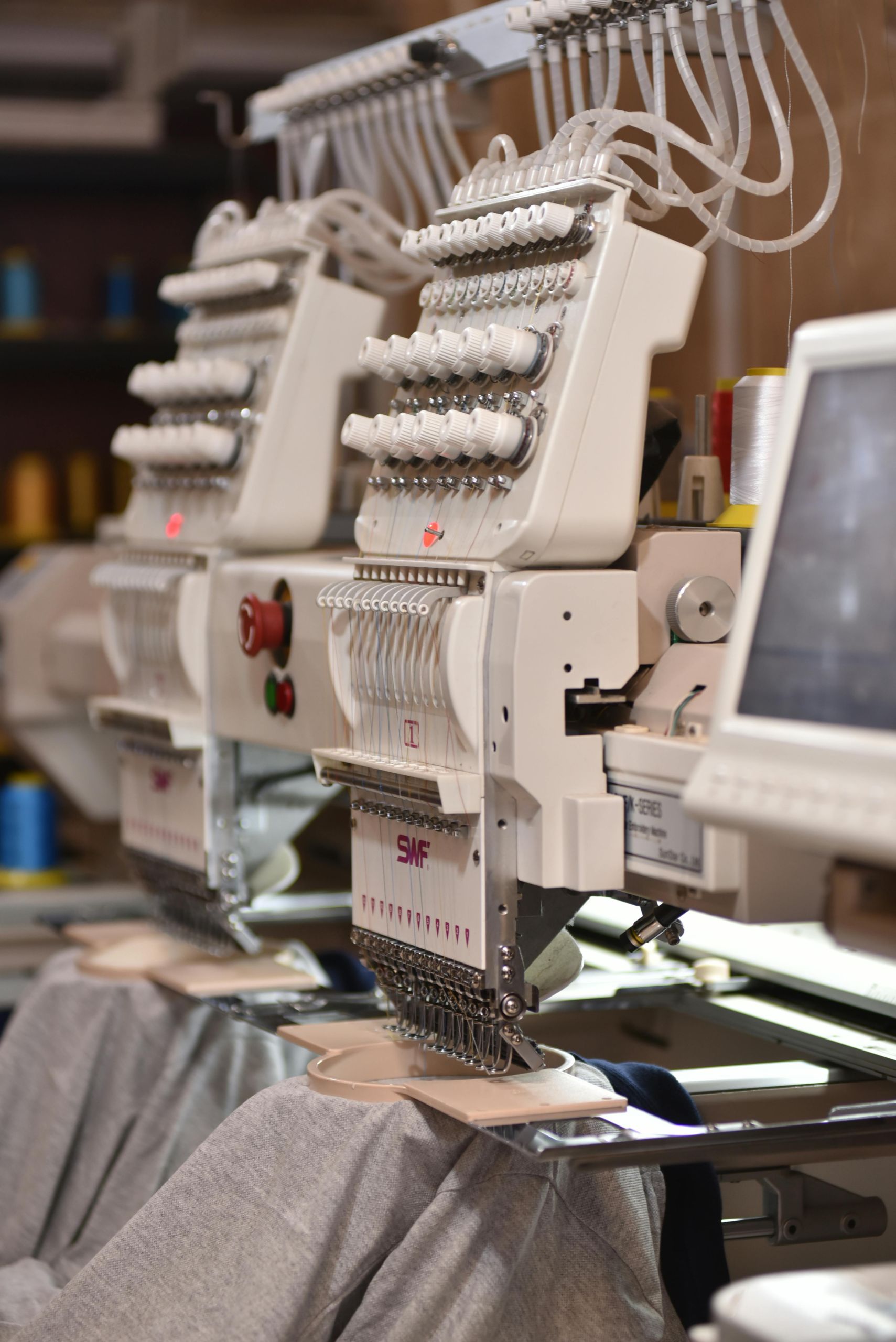
Benjamin Massing will sometimes break even on a production run if it means acquiring a new machine.
“I’ll break even on a job, on a production run for something, but I will have acquired another machine in that process, and I’ll count that as the win.”
The machine represents capability. The ability to do something tomorrow that he could not do today.
This is a deliberate inversion of how most small manufacturers think. Profit comes after capability, not alongside it. Every reinvestment in machinery, technology, or talent compounds the business’s ability to do more sophisticated work, attract better clients, and charge accordingly.
It is also the reason The Massing Group has positioned itself to absorb work as competitors close.
Factories across Los Angeles are shutting down, including, dye houses, screen printers, cut-and-sew operations, while only around 2.5% of apparel purchased in the US is now made domestically, with the number of active manufacturers more than halved since 2001. Massing has done the opposite of shrinking.
He lost everything once. The rebuild worked not because outside money arrived, but because the five principles above. One client first, crowdfund your infrastructure, monetise existing knowledge, protect momentum at all costs, and reinvest capability before profit, added up to something no VC could have funded faster.
The factory he almost lost everything building? It turned out to be worth building twice.
More Articles Like This

How to Choose the Right Materials for Extreme Temperature Environments
Learn how to choose durable labeling materials and adhesives for extreme temperature environments, including UV resistance, thermal expansion, and industrial...

Equipment Investments That Improve Operational Efficiency
The right equipment doesn’t just “get the job done.” It shapes how smoothly work flows, how safely teams operate, and how reliably a business can meet demand.

A Full Guide To High Accuracy Fabrication For Intricate Components
High-accuracy fabrication is about producing the designed part, not a rough cousin of it. Intricate components raise the stakes, since tiny features can shift fit, motion...

How High-Torque Motor Engineering Shapes the Future of Commercial Blenders
High performance of blenders, especially for large and high working kitchens, primarily depends on the power of the motor.

Behind the Manufacturing of Electric Thermo Pots: How Factories Engineer 24/7 Heating Reliability
Under tightly regulated settings, electric thermo pots are made to go on without a break for the purpose of simulating their usage over...

How Baby Appliance Manufacturers Are Redefining Global Safety Standards in 2025
Baby appliance manufacturers put their money on parts that are non-harmful, long-lasting, and simple to wash, thereby meeting worldwide safety requirements for...


