


Wind in Their Sails
One potential solution to the problem of shipping emissions is the force that’s propelled ships across the open water for millennia: the wind.

Written By: Damien Martin
Reading Time: 5 minutes
Tasked with cutting emissions rapidly, ocean shippers are turning to an ancient method with a modern twist
Shipping freight over the oceans is one of the most efficient ways to move goods around the world. But it could always be better. Container ships produce about 3% of the world’s carbon emissions, and the International Maritime Organization has pledged to bring that down to zero by 2050. The bunker fuel ships run on is a strong pollutant, and shippers are racing to find alternatives as the IMO’s targets are 20% emissions reduction from 2008 levels by 2030 and 70% by 2040. One solution is the force that’s propelled ships across the open water for millennia: the wind.
WindWings

The WindWings sails on the Pyxis Ocean bulk carrier vessel rise to 123 feet above the ship’s deck. The brainchild of BAR Technologies, they spent six months on the high seas starting last August and saved 11.2 metric tons of CO2 emissions for each day in operation according to Cargill, which chartered Pyxis Ocean for a pilot test and has engaged 250 ports worldwide to examine the feasibility of accommodating ships with WindWings.
The sails can fold flat on the deck whenever a ship needs to pass under a bridge, but that limits their use to bulk carriers which have storage below deck only. BAR Technologies says it will try fitting ships with three WindWings rather than two on future voyages to further reduce emissions.
“We believe technologies that harness the wind could be an important, cost-effective way to achieve our decarbonization goals in the short, medium, and long-term,” Jan Dieleman, president of Cargill’s Ocean Transportation business, told the BBC.
There’s a reason, of course, that people turned to fuel-powered vessels when the technology came along instead of continuing to rely on the wind. Engines get you where you’re going a lot faster. But as shippers experiment with different fuels, including green methanol and green ammonia, which aren’t as energy dense as fossil fuels, they’re on the lookout for any edge they can get.
“If you can reduce the volume (of fuel) by 30% you have another gain, (in) that you don’t have to put your ship full of tanks instead of cargo capacity,” Dieleman told CNBC. “I do get very excited with the combination of wind plus the new fuels, because new fuels [are] three, four times more expensive, then [by adding wind power] your payback is probably going to be two, three years instead of 10 years.”
Wooden Walls
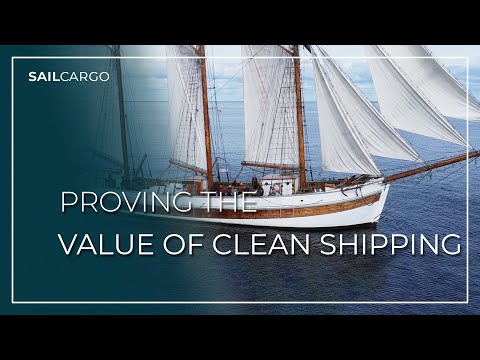
Even more of a blast from the past, Sailcargo’s Ceiba is a 150-foot schooner made from trees in the Costa Rican rainforest. It’s been a work in progress since 2018, and when it sails – the maiden voyage is expected to be in 2026 – it will carry 250 tons of freight. Its first contract is to run green coffee beans from Colombia to New Jersey. Sail Cargo co-founder and builder Lynx Guimond told NPR’s Here & Now that the company’s services are in high demand with companies looking to keep low carbon footprints.
“Shipping is one of the most polluting elements on our planet today,” he said. “But we always say: ‘What’s the real cost of cheap shipping?’ We are paying for it with our planet.”
While Ceiba’s hauls would be a drop in the ocean in a shipping industry that carries more than 10 billion tons of cargo all over the world each year, it might still make a big impression.
“If they succeed, it’s fantastic,” sail-freight expert Steven Woods told Here & Now. “They’ll be sailing right into New York. They’ll be seen by a huge number of people. That would be a huge kickstart to any of these types of projects.”
Sailcargo has also acquired a three-masted wooden schooner called Vega and plans to build a second ship with the same specifications as Ceiba at its Costa Rica dockyard and make other acquisitions to expand its fleet. The ships will be equipped with electric batteries to power them when the winds are not blowing.
Oceanbird

Designed as roll-on/roll-off ships, the Oceanbird fleet will feature expandable wingsails that rotate 360 degrees and tilt down when necessary. They’ll tower 130 feet over the deck and more than 200 feet over the water. The first ship, being built by Wallenius Marine and design firm Knud E Hansen, is targeted for sailing in 2027. With six Oceanbird wings and a specially designed hull, the Orcelle Wind will be optimized for transatlantic routes and be able to carry more than 7,000 cars. It should reduce emissions by 50-60% compared to standard oceangoing vessels.
“Our vision is to lead the way towards truly sustainable shipping, and of course we want others to join us,” Wallenius Marine sustainability lead Per Tunell said. “It is not a competition, but rather a direction we all need to take. By being transparent in the process, we want to inspire others to test the limit of what is possible.”
According to the IMO, there are only about 30 large cargo vessels on the oceans today using wind power, but the number is set to steadily rise.
“To tackle climate change, the shipping industry needs to cut its use of fossil fuel rapidly,” Dr. Simon Bullock, from the University of Manchester’s Tyndall Centre, told the BBC. “These essential technologies make major inroads into that challenge and should be deployed and retrofitted as standard.”
Since 90% of the world’s trade goes via ocean shipping, may the wind be at these shipmakers’ backs.
More Articles Like This

Carry These 7 Tips With You When Starting a Delivery Company
Starting a delivery company can come with complex challenges, so here are several tips that can help at the beginning of the journey.

Smarter packaging in a fast-moving market
Many companies are keen to operate more sustainably, but struggle to balance environmental goals with fast fulfilment. Automated packaging systems offer a practical solution.

What Are the Best Freight Shipping Solutions for Small Businesses?
Balancing shipping cost, speed and safety is essential for small business owners. You need shipments to arrive on time and intact while being cost-effective.

Optimizing Last-Mile Delivery in Maritime Supply Chains
With the help of platforms like https://shipnext.com/, businesses can adopt innovative strategies and technologies to streamline last-mile delivery in maritime logistics.

Transforming Fleet Management with Telematics
Fleets are hard to manage. Vehicles zip around different locations, drivers deal with tricky roads, and paperwork stacks up quickly. Keeping track of maintenance, fuel expenses, and driver...

The Benefits Of Cross-Docking For Faster Order Fulfillment
Quick and direct movement of goods at the point of cross-docking supports increased effectiveness in the logistics process.


