


Doing the Dirty Work
In the process of making worksites safer, construction robots improve production while decreasing costs.

Written By: Damien Martin
Reading Time: 4 minutes
Construction robots take on tasks not safe for human laborers
With labor shortages a fact of life in construction for years, the industry has long been primed for technological disruption. The best part of the wave of construction robots hitting the market now is that they’re taking on the dirty work. Not only do these bots perform a lot of repetitive, dull tasks, but they can also perform a lot of the most dangerous ones. They lift heavy loads and take over jobs that are proven to lead to repetitive stress injuries. In the process of making worksites safer, these construction robots improve production while decreasing costs.
Overhead
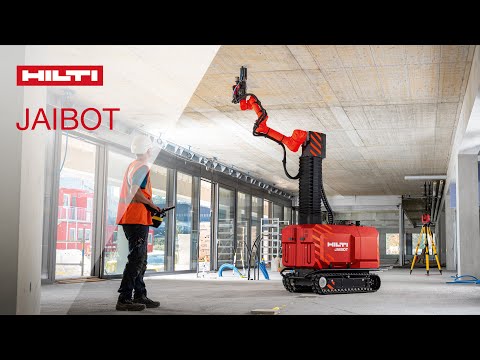
Overhead drilling requires laborers to remain in uncomfortable positions for hours at a time. Holding their arms up the whole time, they’re susceptible to shoulder injuries, and the discomfort often leads to uneven drilling. It’s the same with painting ceilings. Human arms just aren’t built to be in that position for so long. But a robot has no such issues and performs precision tasks for hours before needing to recharge.
Using digital plans and moving about on a mobile platform, the Hilti Jaibot can mark and drill holes and report its progress back to the operator, who needs no robotics training to use it. It can go a full workday, eight hours, without needingto recharge. Okibo’s automated finishing robot can paint ceilings with high quality and consistency at half the cost of manual labor, freeing people up for more valuable and less physically taxing jobs.
Drywall

The Okibo bot does drywall too, and it’s hardly alone among construction robots in that regard. The Canvas drywall finishing machine keeps workers from inhaling dust particles, minimizes repetitive motion injuries, and reduces accidental falls, all while turning in fast, consistent work. It’s been to work in the San Francisco Airport and other high-profile jobs as “a new class of worker-operated machine for construction,” according to Crunchbase.
Before the drywall is finished, though, someone – or some bot – needs to put it up. Developed at Japan’s National Institute of Advanced Industrial Science and Technology, the humanoid construction robot HRP-5P can install drywall sheets and use power tools without a human operator.
“By equipping this with robot intelligence consisting of environmental measurement/object recognition technology, whole-body motion planning/control technology, task description/execution management technology, and highly reliable systemization technology, it is possible to perform plastering, a typical heavy labor task at construction sites,” its creators say.
Bricks & Rebar

There are few jobs on a construction site more strenuous than bending and tying rebar. Advanced Construction Robotics’ TyBOT doesn’t mind it, though. It can tie 1,200 bars an hour and doesn’t need to take a break when at night or in the rain. TyBOT navigates its working area without pre-mapping or BIM input and goes 12 hours without refueling. When used in conjunction with IronBOT, which can place 5,000 pounds of rebar per hour, it can cut rebar installation time in half.
Laying bricks is no picnic either, but it’s easy for Construction Robotics’ SAM System, which picks up bricks, applies mortar, and places the bricks, with a mason supervising. The company’s MULE can lift materials a lot heavier than bricks, drastically reducing injury risk to workers charged with moving heavy materials around a site.
Out of This World

There might not be a tougher work environment than space. The Canadian government’s Canadarms series, with permanent placements on the ISS and Lunar Gateway have seven degrees of freedom and can move in much the same way a human arm can. On the Canadarm3 designed for the Lunar Gateway, each joint will rotate 360 degrees, and a 3D vision sensor tool will map objects around it. As with Canadarm2, force-movement sensors will provide it with a sense of touch and it will have automatic collision avoidance capabilities.
At 6-foot-2, 300 pounds, NASA’s Valkyrie is about the biggest astronaut you’ll ever see. It’s also great at doing the dirty work that might put human astronauts in danger. Teleoperated through a VR headset, Valkyrie is dexterous enough to use power tools and can work in degraded or damaged human-engineered environments. Originally conceived in the wake of the Fukushima nuclear disaster, Valkyrie should one day ply its trade on the moon and perhaps even Mars.
It’s a tough job, but somebody has to do it.
More Articles Like This

Proptech & Consolidation: Reshaping Real Estate’s Future
Proptech and mergers are reshaping real estate. The Compass-Anywhere deal shows how firms use tech and scale to compete in a tighter market.

What Is the Best Heavy Equipment for Large-Scale Construction Projects?
Learn how to select heavy equipment for construction projects while boosting your return on investment, reducing risk, and using the latest technologies to keep efforts...

From Emergency to Cosmetic: One Dental Office for All Your Needs
Modern dental care has evolved far beyond the days of uncomfortable chairs and sterile environments. Today, dental offices have transformed into comprehensive care hubs...

Decommissioning Decoded: Unlocking 6 Upsides of Facility Closure
Learn about the six upsides of facility closure to decide on the fate of unprofitable assets for the benefit of the organization over the long term.

Smart Strategies for Managing Commercial Property Damage
Managing commercial property damage is a critical task for any business owner or property manager. Damage can occur suddenly due to natural disasters, accidents, or unforeseen...

The New Town Renaissance: Why Planned Communities Are Cool Again
Find out why planned towns are making a comeback. Let's take a look at why planned communities are cool again.


